
FDJ Score: 7.5/10 (High Two-Star Level)
Review
La Chèvre d’Or was not the original reason for our journey to the Côte d’Azur. I had come with three friends to visit Mirazur in Menton, where Mauro Colagreco was marking the restaurant’s twentieth anniversary with a special menu. We decided to extend the trip into a small Riviera sequence and also include a dinner at Le Louis XV, Alain Ducasse’s grand institution at the Hôtel de Paris in Monaco, followed the next day by lunch at La Chèvre d’Or in Èze.
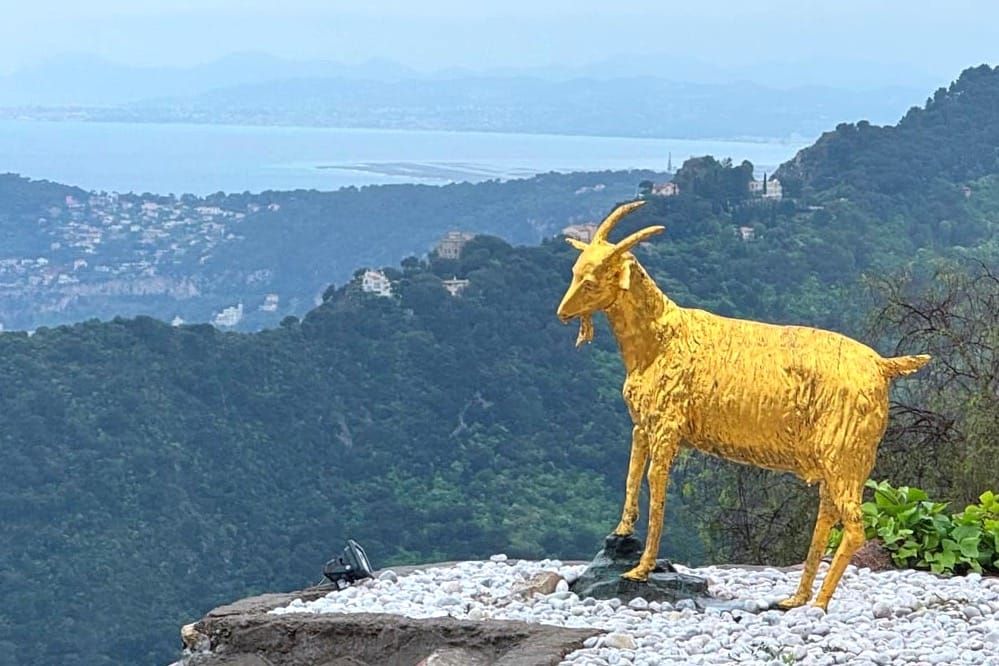
It is a restaurant that carries a particular mythology. Set between Nice and Monaco, above the Mediterranean, La Chèvre d’Or is known as much for its view as for its cooking. The name itself, the golden goat, has always suggested something slightly unreal, perched between legend, luxury, and landscape.
Since 2024, the kitchens have been led by Tom Meyer, who took over from Arnaud Faye and has maintained the restaurant’s two Michelin stars. The achievement matters. In a house this visible, continuity is never neutral. It must be earned quietly, service after service.
Location & Atmosphere
Arrival at La Chèvre d’Or is already part of the experience. Èze rises steeply from the coast, its stone lanes compressed into the medieval village above the sea. There are restaurants where the dining room begins at the table. Here, it begins with the ascent.
The history of the place is carefully layered. The château was purchased in 1953 by hotelier Robert Wolf, who transformed it into a restaurant; the story of La Chèvre d’Or, according to the hotel’s own history, truly began in 1956. Rather than calling it simply a founding member of Relais & Châteaux, it is more accurate to describe it as one of the early addresses associated with La Route du Bonheur, the route that preceded and shaped the spirit of Relais & Châteaux.
Then one climbs the stairs toward the restaurant and enters another atmosphere entirely. The dining room has recently been redesigned, and it no longer leans on old Riviera grandeur alone. It feels contemporary, soft, and composed, with pale beige tones, a quiet carpet underfoot, and large windows that refuse to let the interior become the main subject.
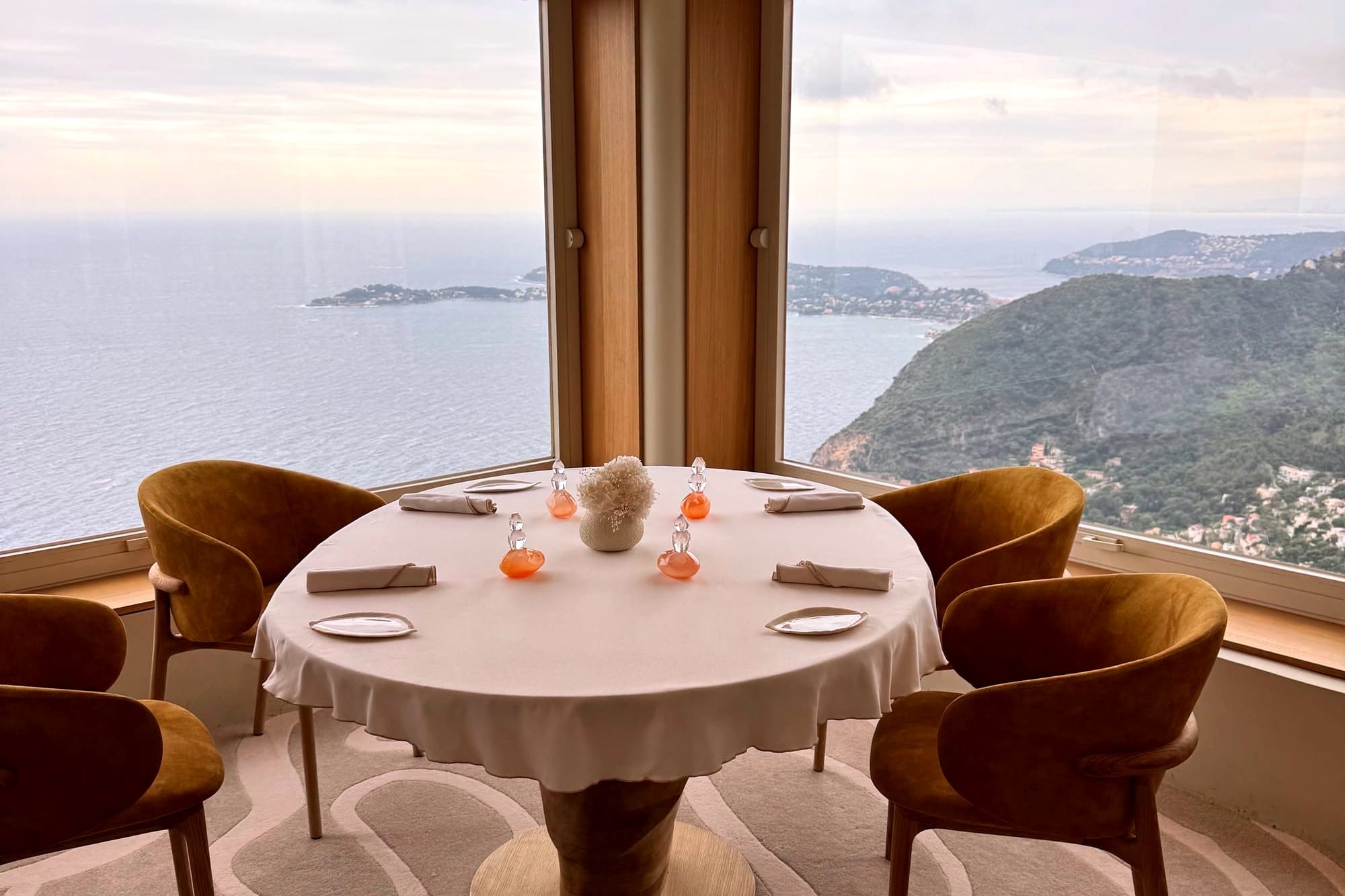
The view remains almost impossible to ignore. We were given what must be one of the best tables in the room, facing the sea and Saint-Jean-Cap-Ferrat. From there, the Mediterranean does not appear as a background but as a presence. The light shifts slowly. Boats become small white marks. Conversation lowers itself naturally.
Culinary Style or Distinctive Character
Tom Meyer (32) is young for such a house, but the cooking does not try to prove youth through noise. His menu, at least at lunch, moves in a lighter Mediterranean register: seasonal, precise, and often green in tone. There is a noticeable desire to bring the restaurant closer to the landscape outside the window rather than to preserve it as a formal monument.
The redesign of the dining room seems to follow the same thought. It softens the room around the cuisine. Nothing feels aggressively staged. The luxury is there, but it has been absorbed into texture, spacing, and silence.
Later, during a visit to the kitchen, we met Meyer briefly. It was a small but revealing moment. The atmosphere behind the dining room felt calm and relatively relaxed, not theatrically tense. That matters. In restaurants at this level, one often senses whether precision is created through fear or through concentration. Here, at least from that brief glimpse, the room behind the room seemed to breathe.
There is considerable potential in this new chapter. The restaurant already holds its two stars, and Meyer has maintained them. The more interesting question is how clearly he can define La Chèvre d’Or for the next decade.
Menu / The Dishes
The six-course lunch menu was priced at €250. It unfolded as a light, seasonal Mediterranean meal, never heavy, never overburdened by the view, and at its best when acidity, herbs, and marine flavours were allowed to remain lucid.
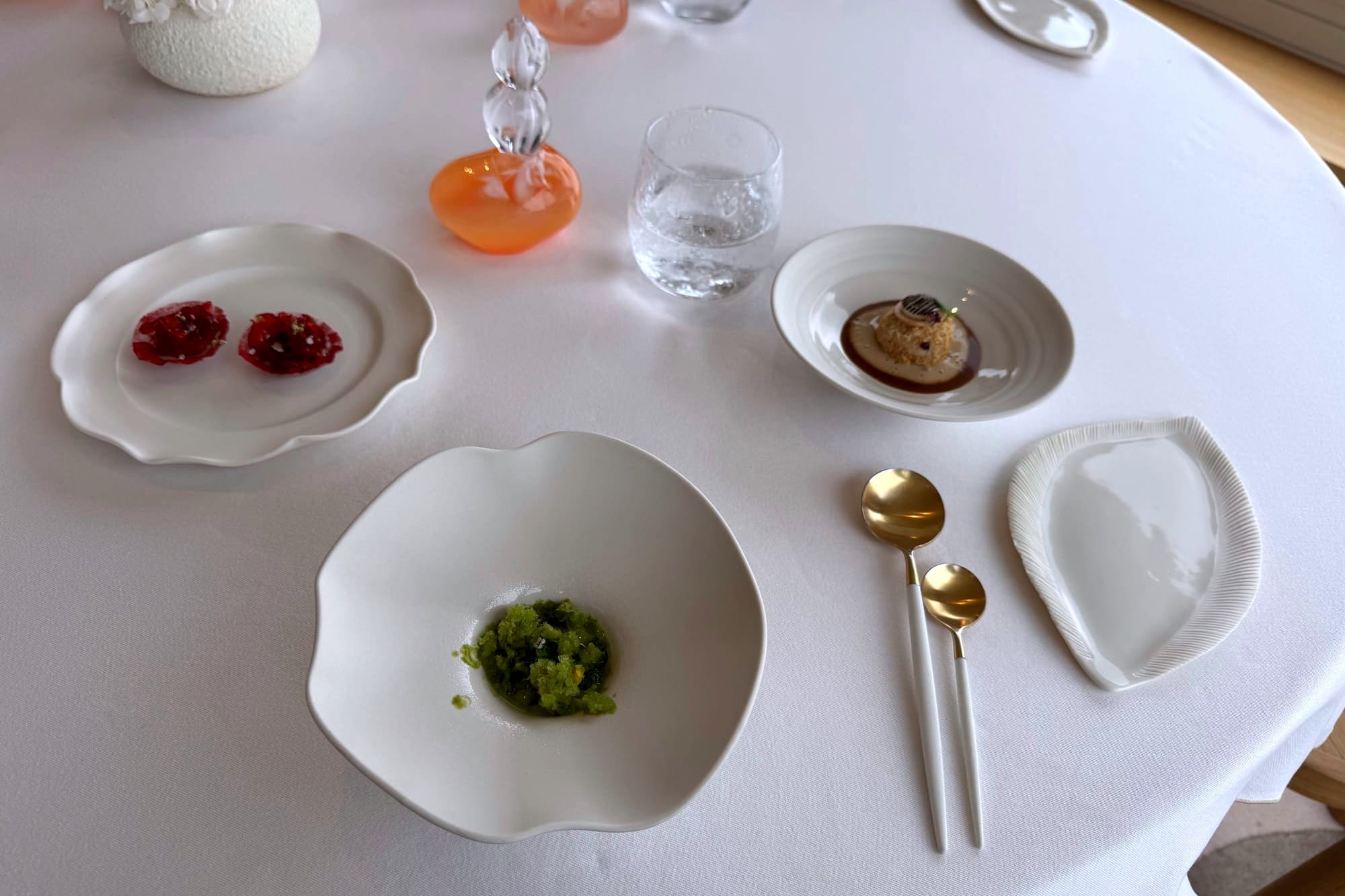
Before the formal menu began, a sequence of amuse-bouches arrived.
Among them, the crab cake stood out. It had the kind of immediate pleasure that can be difficult to achieve in a gastronomic opening: crispness, warmth, sweetness, and just enough structure to prepare the appetite without exhausting it.
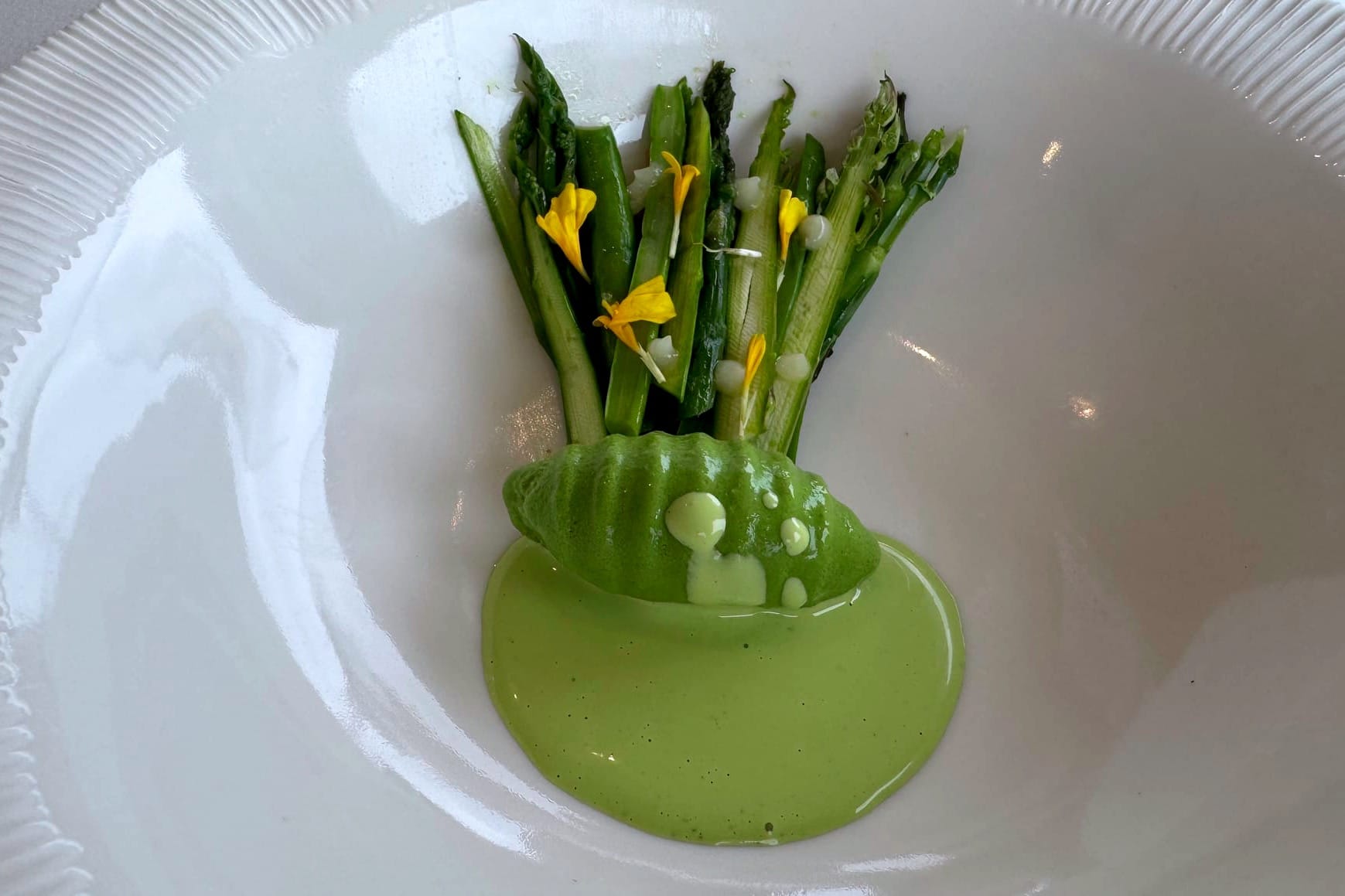
The first course, green asparagus with rose from Grasse, basil, and gorgonzola, was one of the most convincing dishes of the meal. It was green in the fullest sense: fresh, light, vegetal, and aromatic, with the rose handled delicately enough not to become cosmetic. The gorgonzola brought a soft lactic depth, giving the asparagus a little shadow without pulling the dish away from spring.
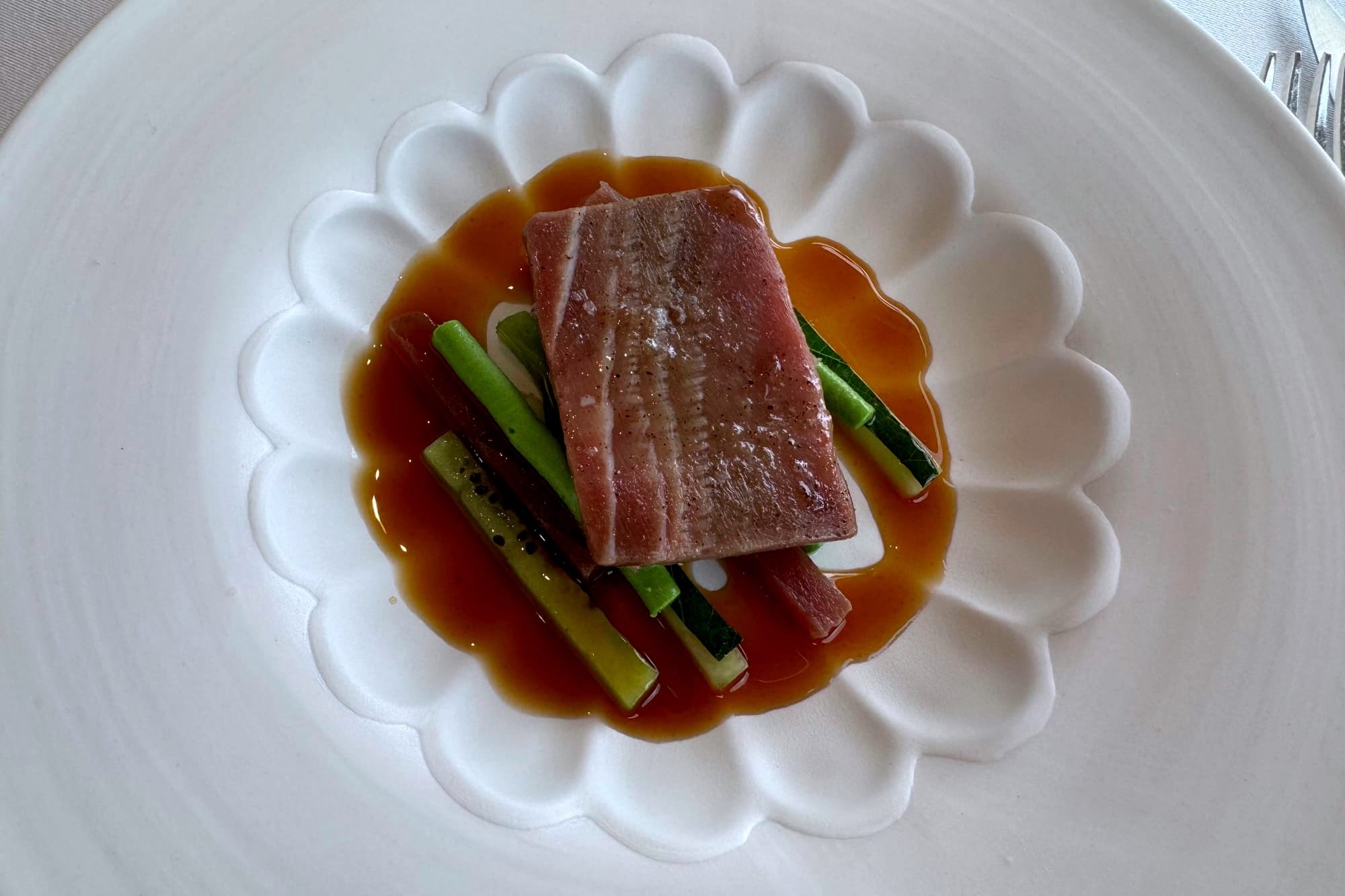
The red tuna with cucumber, kiwi, and shiso was the most striking composition. Raw red tuna formed the centre, clean and cool, while cucumber and kiwi added freshness and a fine, almost electric acidity. Above it came grilled tuna belly, richer and warmer, bringing smoke, fat, and contrast. It was a dish of temperature and texture as much as flavour, and it showed Meyer’s ability to build complexity without heaviness.
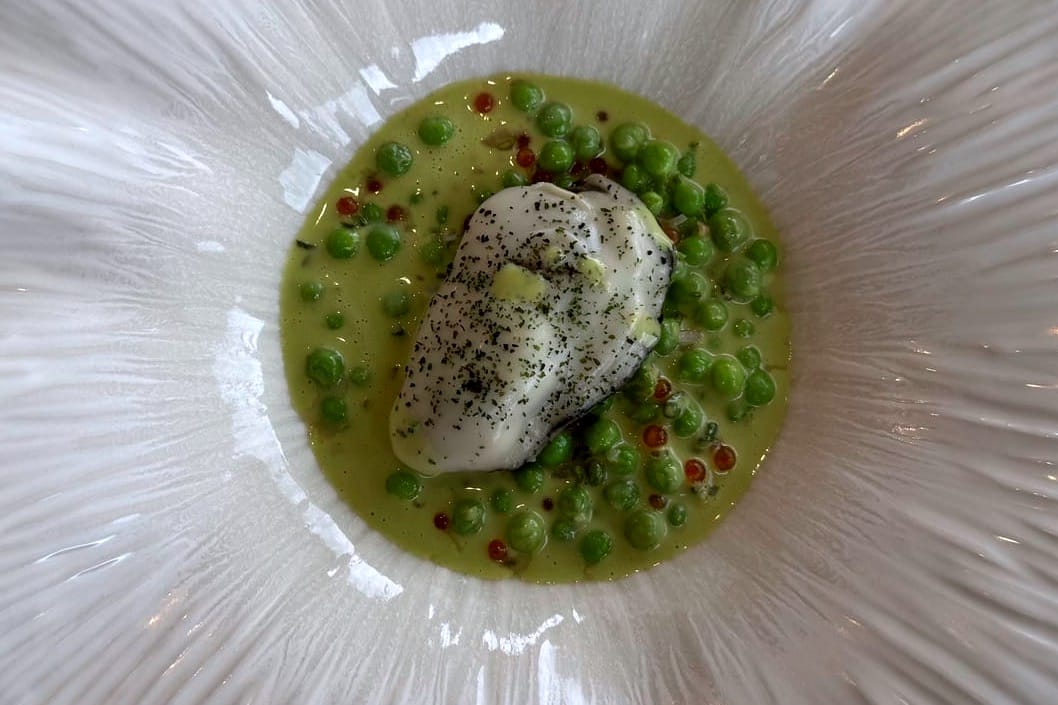
Oyster No. 3 with green pea, lovage, and champagne continued the spring logic. The oyster was grilled, which changed its character from bracing and saline to something rounder, warmer, and more yielding. Green pea gave sweetness, lovage added its celery-like aromatic edge, and champagne brought a discreet lift. It was a beautiful spring dish, confident in its restraint.
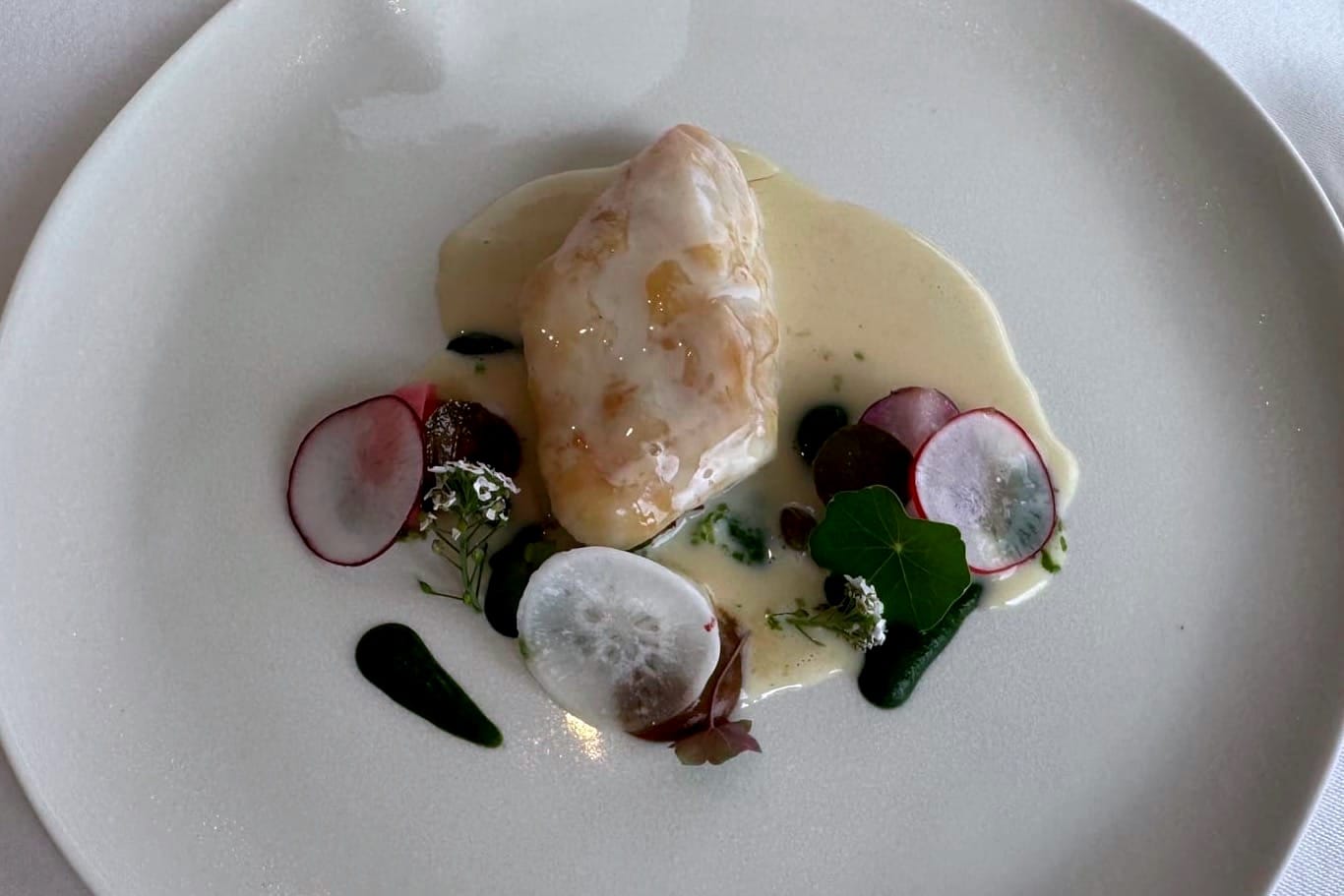
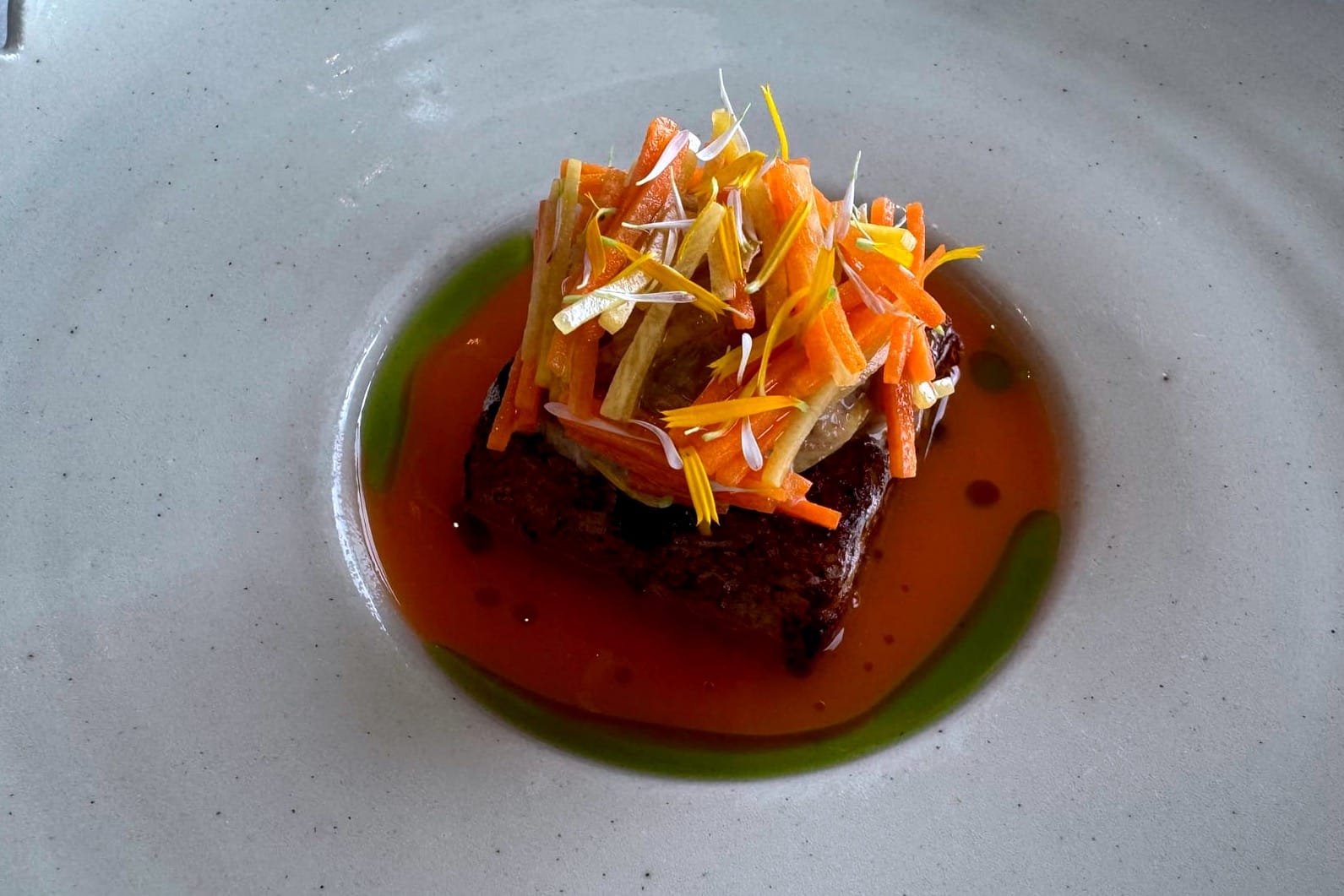
Royal sea bream with nasturtium, radish, and beurre noisette was more technical than emotional. The fish was cooked precisely, still slightly translucent at the centre, with the kind of control one expects at this level. Nasturtium and radish brought pepper and freshness, while the beurre noisette added warmth and a nutty finish. It was exact and well made, though less memorable than the preceding courses.
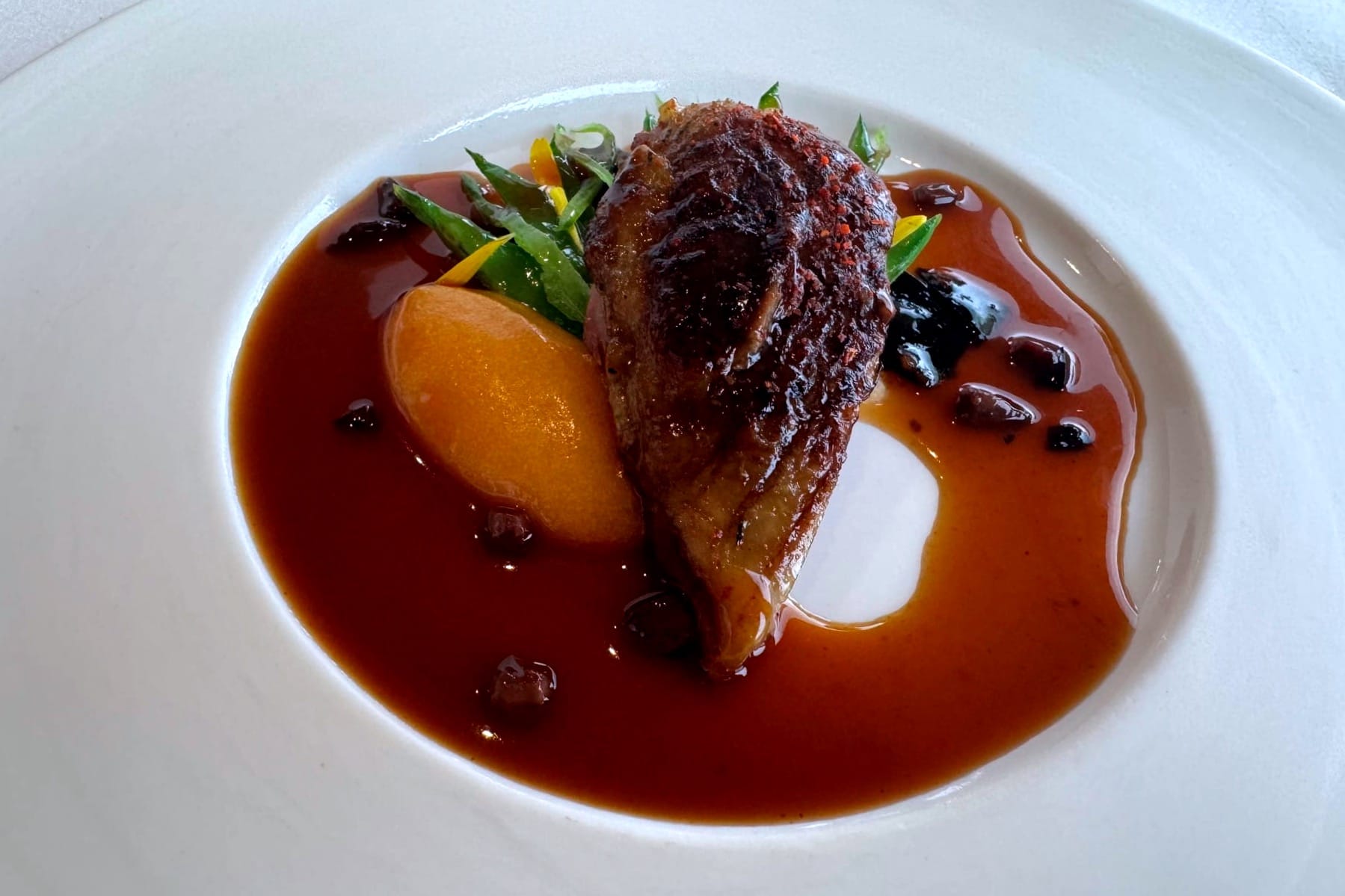
The quail with kombu seaweed, dried apricot, and Macvin moved the meal into deeper territory. Here the flavours became more intense, more autumnal in feeling despite the spring structure of the menu. Kombu brought umami, the dried apricot a darkened sweetness, and the Macvin a vinous, slightly oxidative resonance. It was a strong dish, compact and expressive.
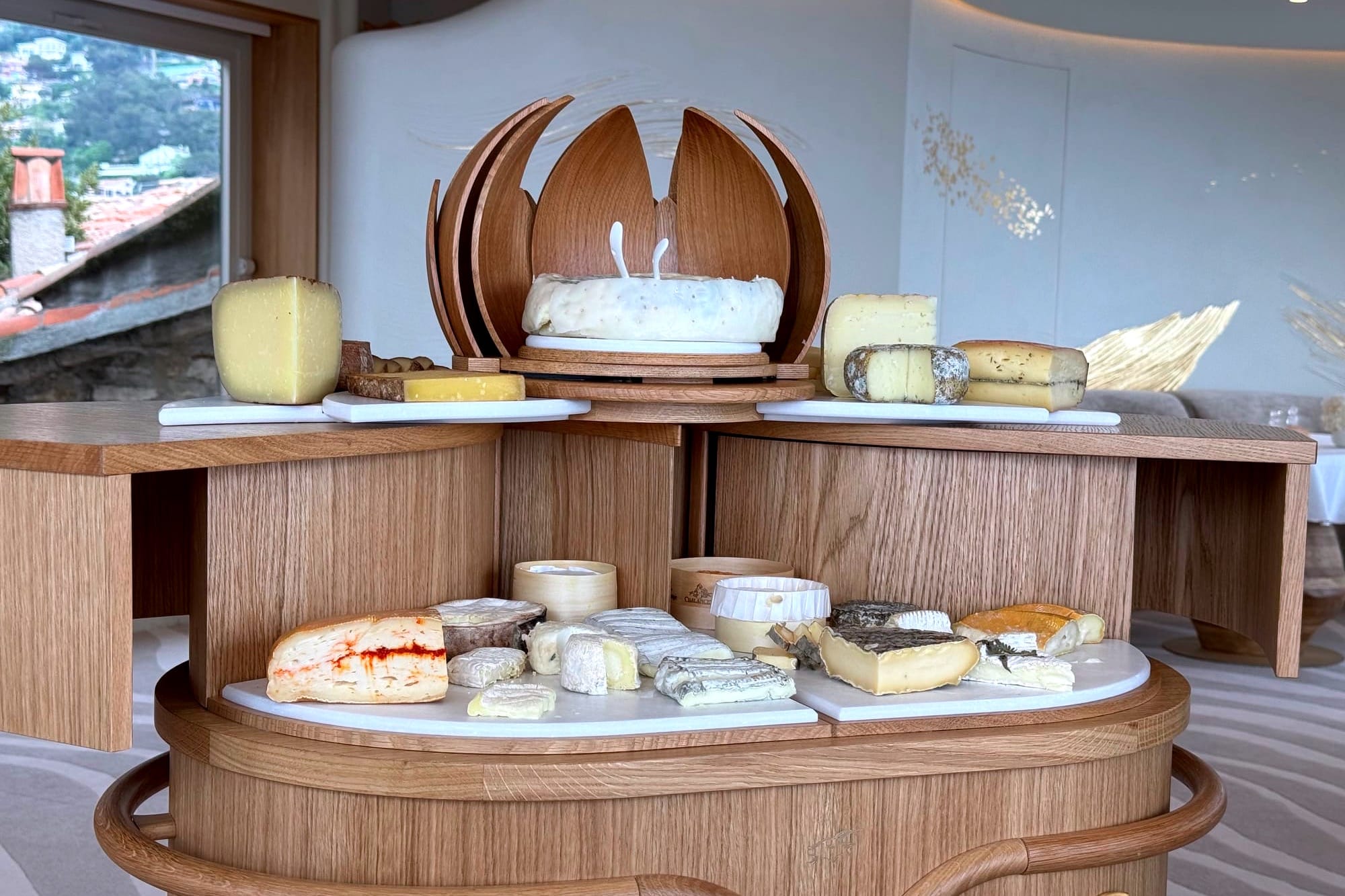
We added cheese from the trolley, a decision that felt right in such a classical house. A cheese trolley has a way of slowing the rhythm of a meal. It asks for conversation, for small decisions, for an appetite that is no longer purely hungry but curious.
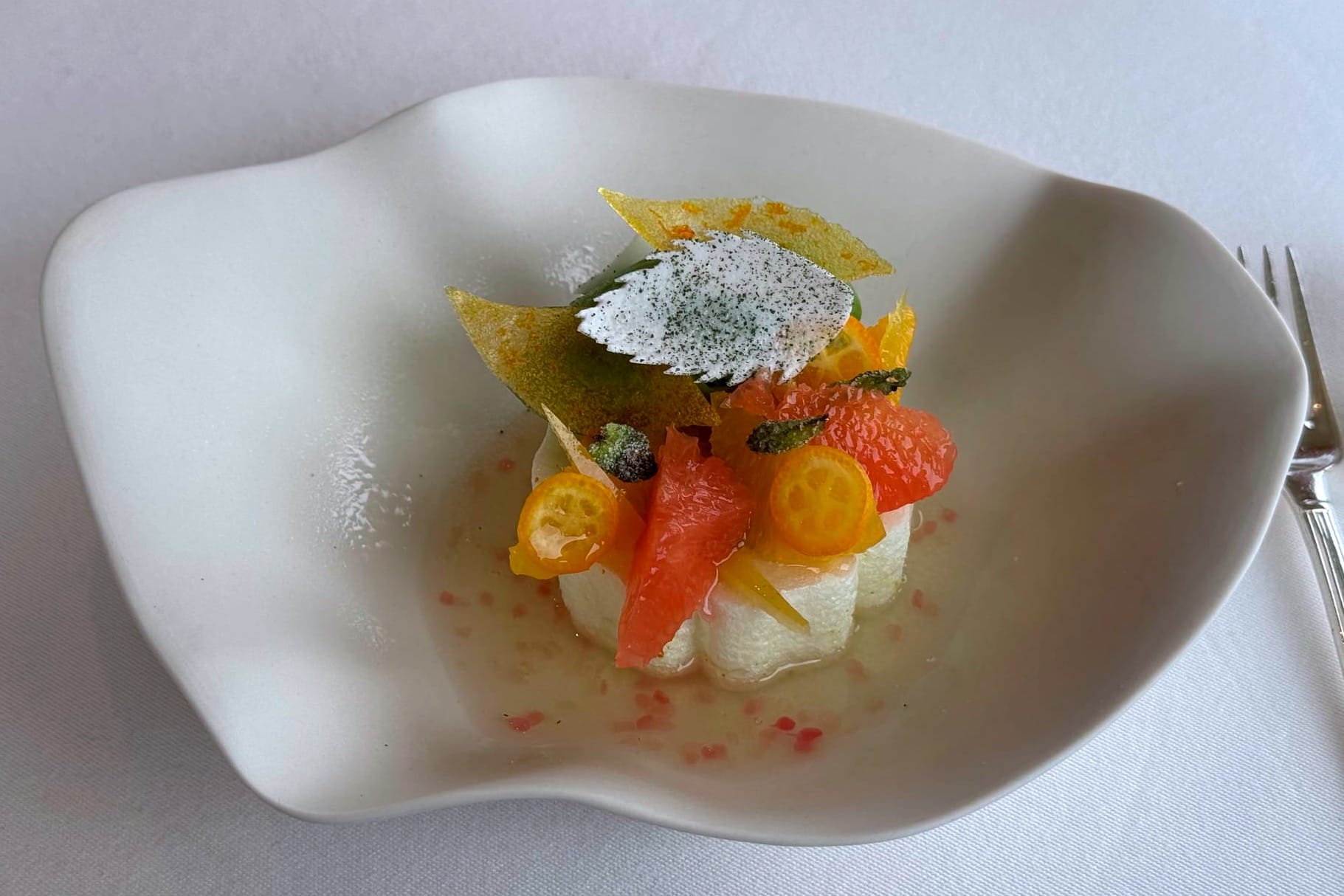
Dessert returned to brightness: citrus from the garden with spring herbs and meringue. It was fresh, clean, and sharply drawn, with enough sweetness from the meringue to soften the citrus without muting it. After the quail and cheese, this was exactly the kind of ending the menu needed. Not grand, but clear.
Wine
The wine sequence had its own quiet logic, since we stayed entirely within Chardonnay, though in three very different expressions.
We began with Champagne Dhondt-Grellet, Cramant Grand Cru Blanc de Blancs Extra Brut. As a pure Chardonnay from the Côte des Blancs, it gave the meal a precise opening: chalk, citrus, tension, and fine bitterness. It worked particularly well with the first bites and the early green tones of the menu, where freshness mattered more than weight.
The 2015 Montagny from Maison Leroy shifted the register. Montagny, from the Côte Chalonnaise, often shows Chardonnay in a slightly less ostentatious but deeply satisfying Burgundian form. In this context, and especially with the asparagus and oyster, it offered breadth without becoming too rich. The maturity of the vintage gave it a calmer, more settled expression.
The Ladoix Chardonnay 2019 brought another face of Burgundy: more Côte de Beaune in character, with a firmer structure and a little more presence. It suited the sea bream and quail better than the earlier wines, not because it overwhelmed them, but because it had enough depth to follow the menu as it moved away from pure freshness.
Drinking three expressions of Chardonnay across one lunch was more interesting than a broader pairing might have been. It allowed small differences to become visible: Champagne as line and energy, Montagny as maturity and quiet generosity, Ladoix as structure and depth. The grape remained the same, but the meal showed how place, method, and age can alter its voice completely.
Verdict
La Chèvre d’Or remains one of the great dining rooms of the Riviera, but under Tom Meyer it does not feel trapped by its own legend. A restaurant with this view could easily let the landscape do too much of the work. Here, the view is still spectacular, but the cooking earns attention on its own terms.
The strongest dishes were those most closely connected to season and place: the asparagus, the tuna, the oyster, and the citrus dessert. The sea bream was precise, if less memorable, while the quail suggested a deeper, more intense side of Meyer’s kitchen.
What felt most convincing was the clarity of his vision. La Chèvre d’Or does not give the impression of a young chef merely occupying a historic room. The recent redesign has softened the old formality and brought the restaurant closer to his cuisine. Even a small detail, such as Meyer discussing the design of the cheese trolley with the carpenter, revealed a chef thinking beyond the plate: about movement, service, material, and memory.
There is clarity here, and considerable promise. The golden goat still looks out over the Riviera, but the restaurant no longer feels held in place by its legend. Meyer has maintained its two Michelin stars and begun to shape the house around his own idea of Mediterranean cuisine. This is a place to watch.
The meal lingered as a feeling of precision and calm: pale light, green flavours, a confident kitchen, Chardonnay in three shades, and the sea below Èze holding everything in place.
• Location: Èze, France
• Chef: Tom Meyer
• Michelin rating: ★★
• Visited: April 2026