
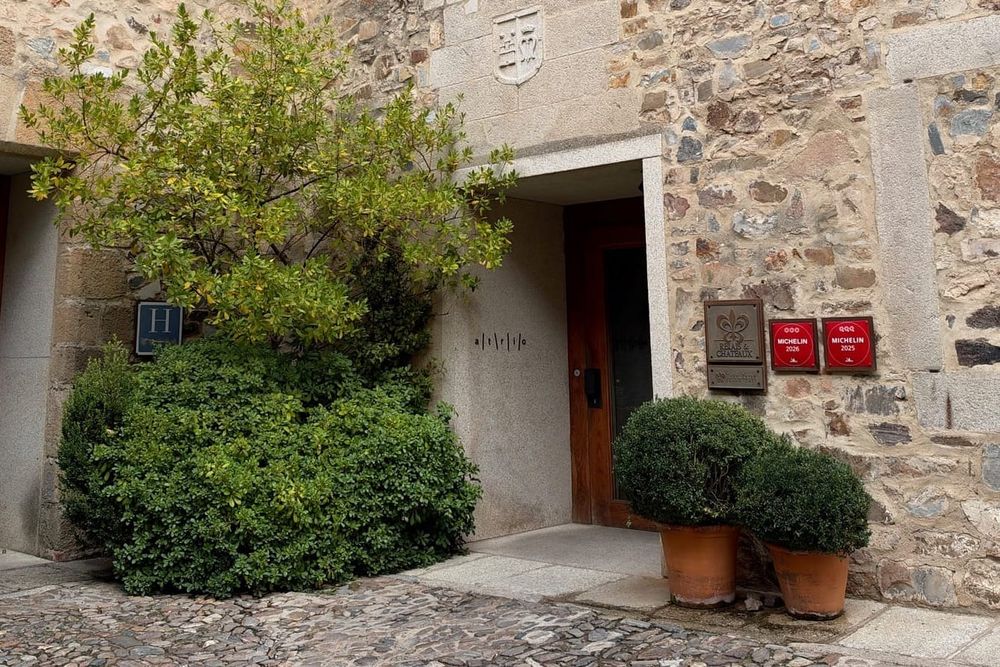
FDJ Score: 8.5/10 (Solid three-star level)
Review
Nobody ends up in Cáceres by accident. The city lies in Extremadura, well away from Spain's usual routes, and for most visitors from abroad getting there means a flight into Madrid and around three hours by car to the west.
Michelin describes three stars as cooking worth a special journey. In Paris or London that definition is easy to satisfy: the journey is to the city, and the restaurant is one evening among many reasons to be there. At Atrio the journey is meant literally. Hardly anyone is in Cáceres for a meeting and books Atrio because the evening happens to be free. The trip, the town and the table form a single experience, which puts Atrio closer to the great French country houses, places like Baumanière in Les Baux, than to any city restaurant. It has the hotel to match. Since the 2023 guide the restaurant has held three Michelin stars, and the hotel carries three Michelin Keys, the guide's highest distinction for hotels.
This was my third visit. The first, in February 2011, came about by chance on a family road trip, at the restaurant's original address on Avenida de España; by my reconstruction, only days before it moved into the old town. Our son was four. Atrio remains the most child-friendly starred restaurant we have ever been to, and it managed that without lowering anything: white gloves, the full ceremony of every course, service and atmosphere at the very top level. In 2015 we came back during Semana Santa, stayed at the hotel and ate here on both evenings.
Toño Pérez cooks and José Polo looks after the wine, as they have since opening in 1986. There is one tasting menu, the Iberian Pork Menu: twenty-two courses plus small bites and petit fours, for €295.
Location & Atmosphere
The drive west from Madrid runs through the dehesa, the open oak pasture where Iberian pigs are raised, so the main ingredient of the evening is on view long before the first course.
Cáceres itself would be worth the trip without a restaurant. The walled old town has been a UNESCO World Heritage Site since 1986 and is one of the best preserved in Spain. Almohad towers still stand along the walls, and inside them the lanes climb between Gothic and Renaissance palaces, many with the coats of arms of their noble families carved above the doors. Storks nest on the church towers. Much of the centre is closed to traffic, and after dark, when the day visitors have gone and the stone is lit, it can feel as if very little has changed in centuries. Our 2015 visit coincided with the Semana Santa processions, candles and drums moving slowly through those narrow streets.
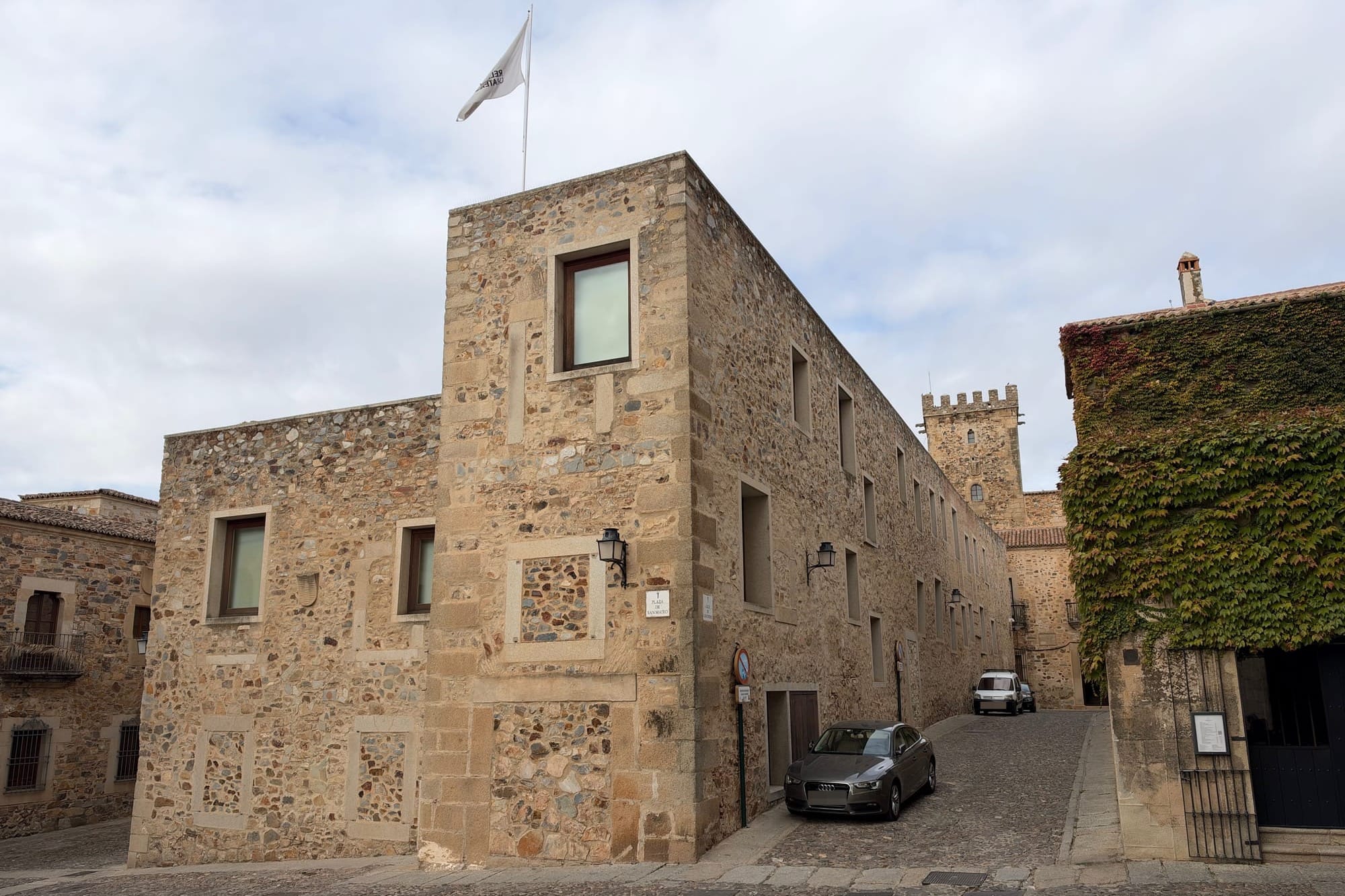
Atrio sits on Plaza de San Mateo, close to the highest point of the old town. Emilio Tuñón and Luis Moreno Mansilla rebuilt the site, keeping old stone on the outside and a modern interior behind it.
Before dinner, we were offered a tour of the wine cellar. A member of the sommelier team led us down and asked, courteously, that we take no photographs of the bottles. That request has a history. In October 2021 a couple staying at the hotel left with 45 bottles, including an 1806 Château d'Yquem and several Romanée-Conti, together reportedly worth more than €1.6 million. Five years on, the racks still hold enough to explain the caution.
Culinary Style
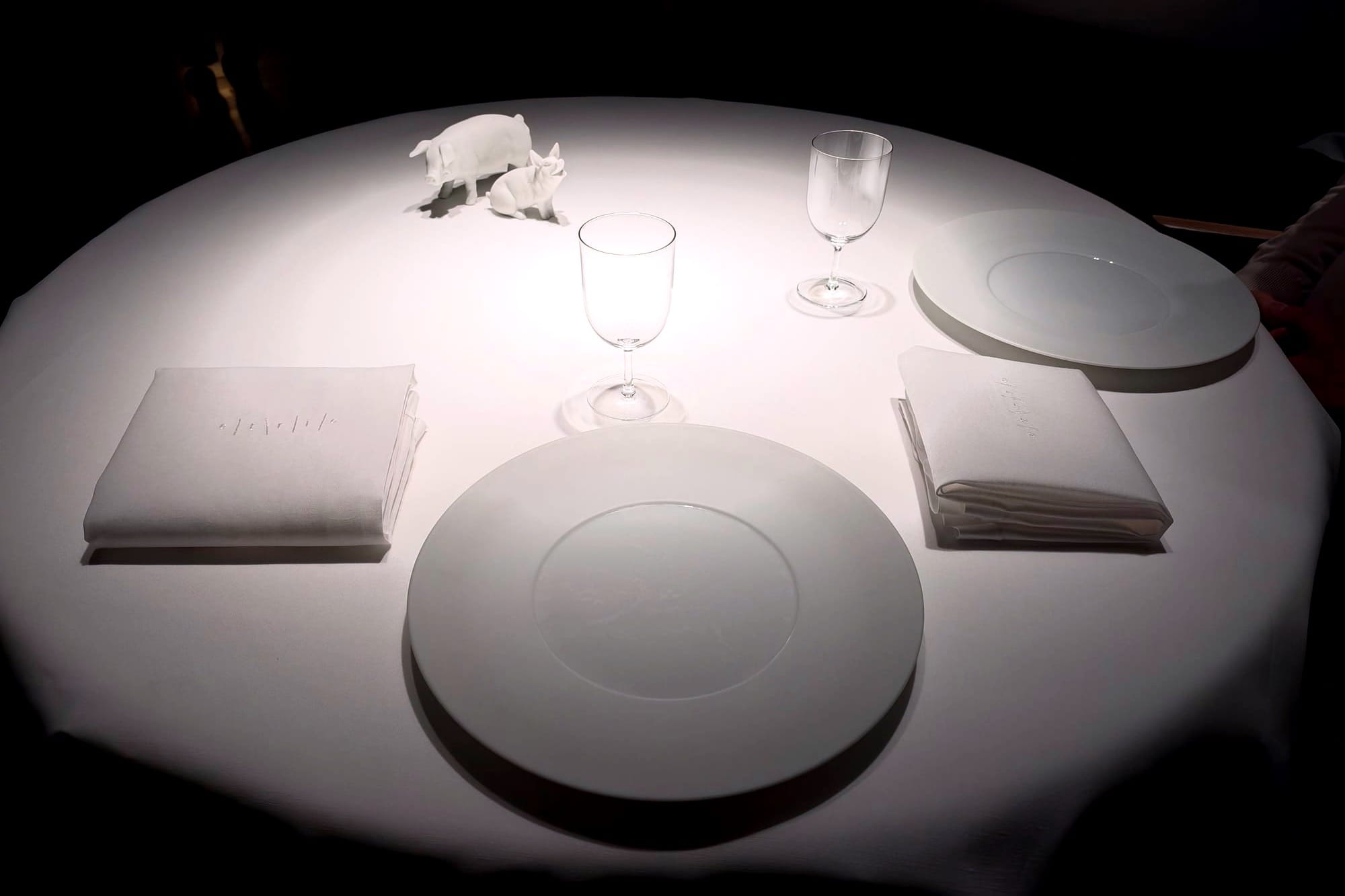
The organising idea is the Iberian pig. It appears in almost every course, and Pérez uses all of it: fat, skin, collagen, ears, cheek and jowl as much as the prime cuts. The menu tells this as a little story in three chapters, following "Cochinito" to the beach, then on a break in the dehesa, and finally to its sweet side.
Aponiente, on the Bay of Cádiz, is the mirror image. Over eighteen visits to Ángel León's tide mill I have watched him turn fish into charcuterie, down to a "ham" of bluefin tuna belly aged in the manner of Ibérico. Atrio works from the other side. Here the pig travels to the sea, so pork fat meets tuna belly and caviar, and a pork sauce ends up under lobster.
Menu / The Dishes
Twenty-two courses, with a few small bites besides, and dinner lasted well over three hours. It still felt quickly served. Plates followed one another at a steady pace, and over that length the courses begin to blur into each other in memory. Some of what follows is detailed. Some of it is little more than what was on the plate.
Black olive tapenade with linseed and amaranth opened the evening.
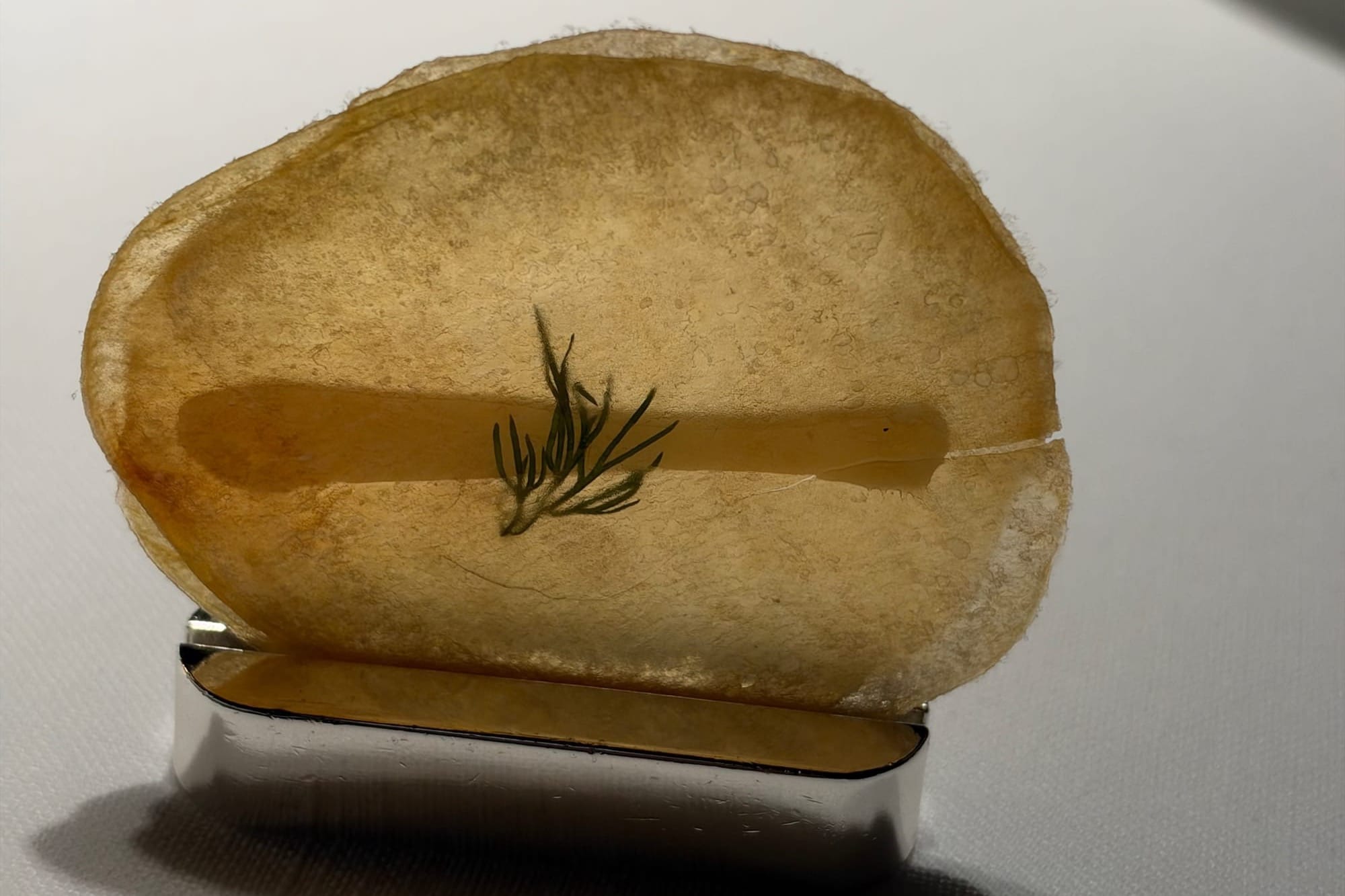
Then potatoes with cheese and dill.
The third snack was choux pastry, filled with smoked bacon and oregano.
"Cochinito" Goes to the Beach…
The tuna belly arrived with red lard and caviar on top. Fish fat and pork fat sat together on one spoon, with the caviar's salt running through both.
A tapioca crunch carried salmon emulsion and crispy pork.
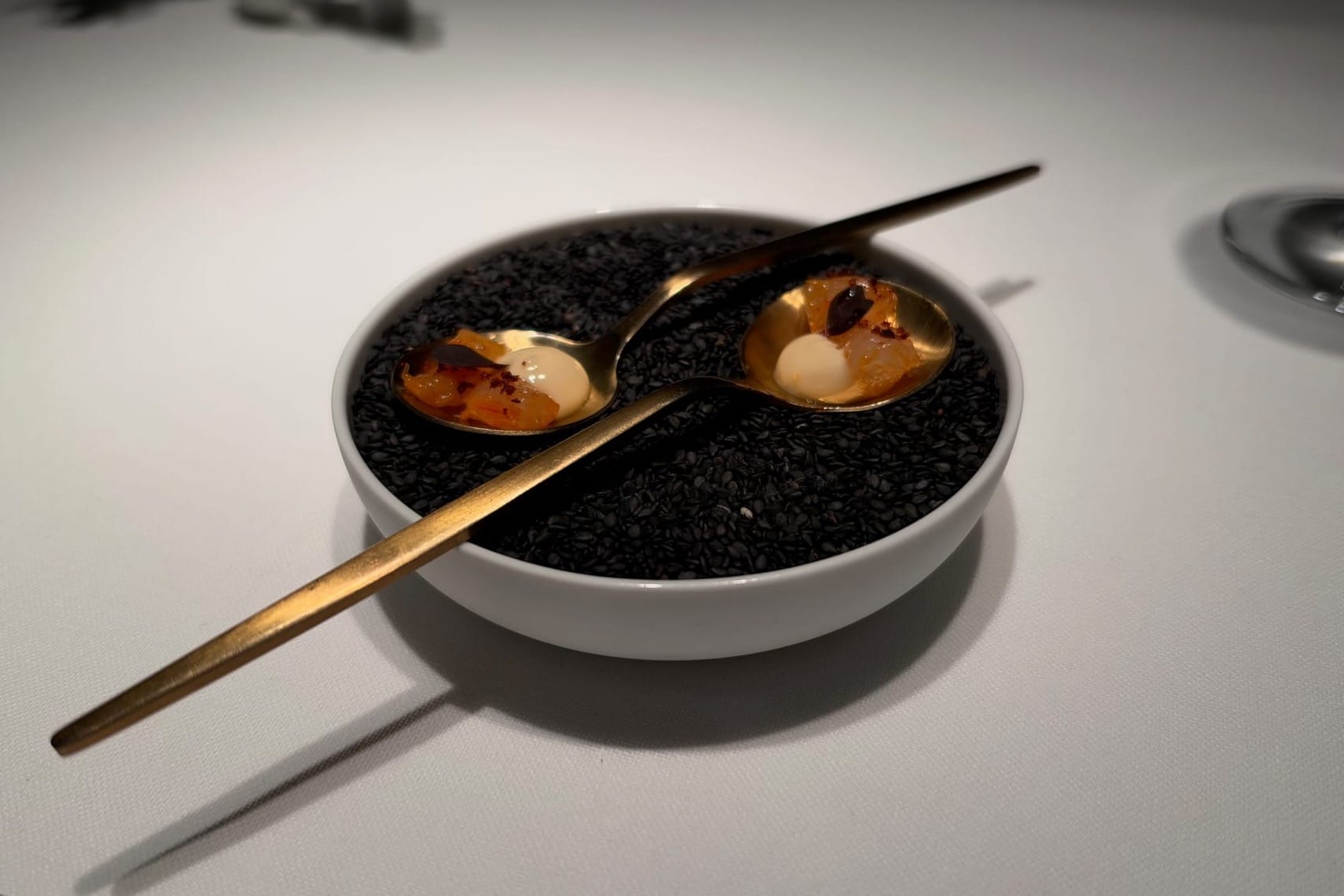
Shrimps marinated with garlic and chorizo brought the most plainly Spanish flavours of the night.
When the "Cochinito" Takes a Break in the Dehesa…
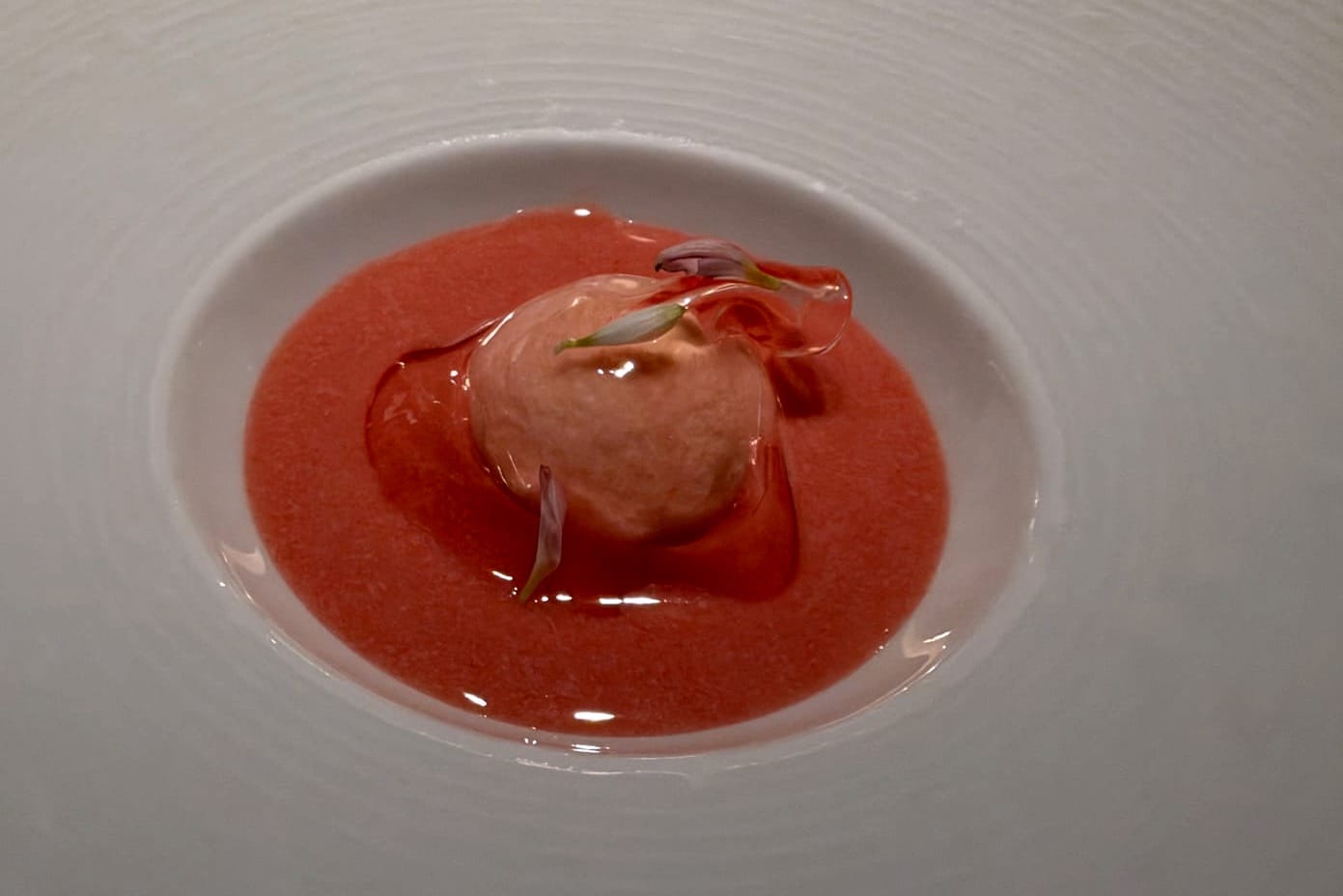
Jamonesa is the kitchen's name for ham with mayonnaise and tomato.
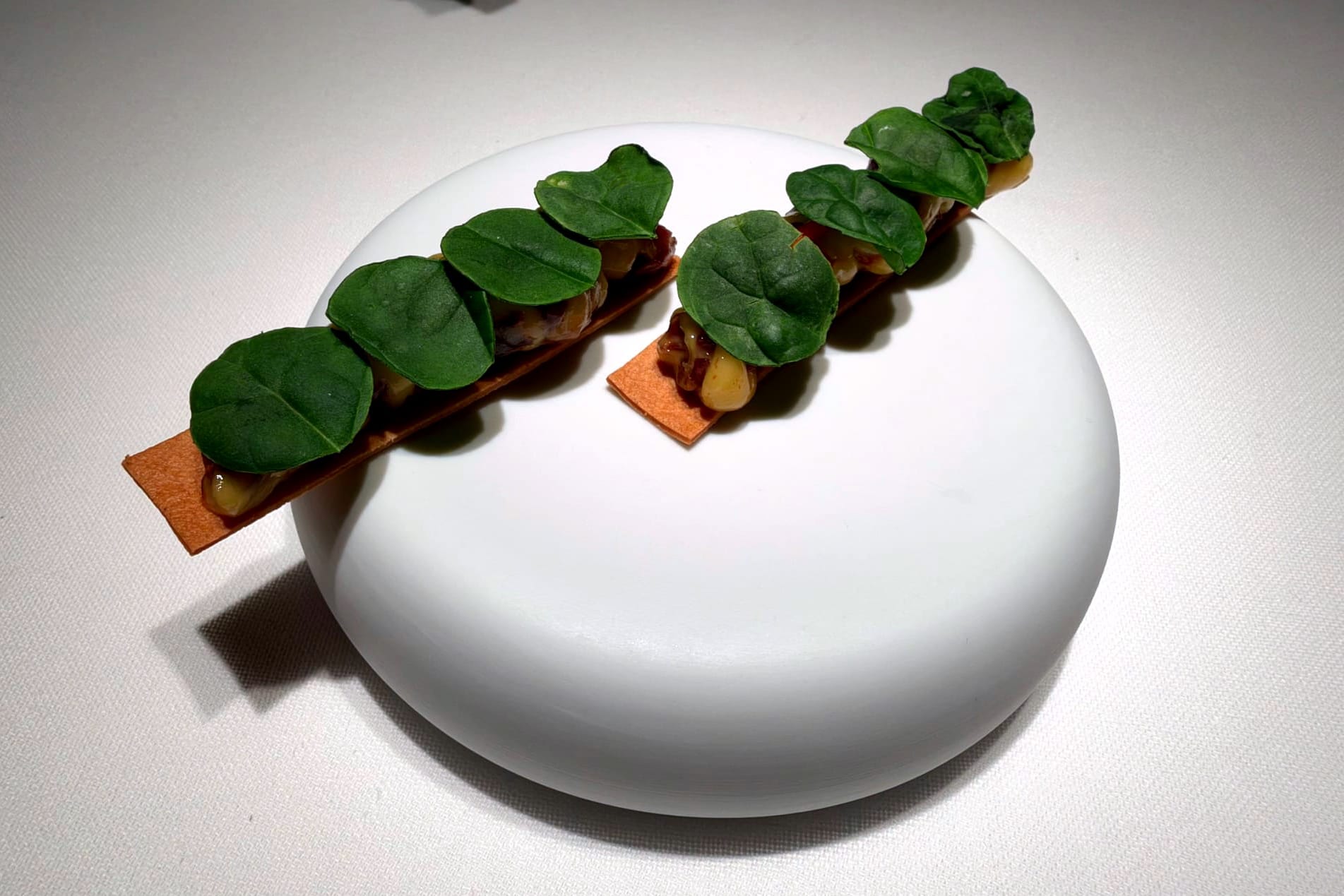
Salchichón came on two long, thin strips of crispy wheat laid across a smooth white dome, the pieces glossed with black pepper emulsion and covered with a row of small round green leaves. It became one of my favourite dishes of the evening.
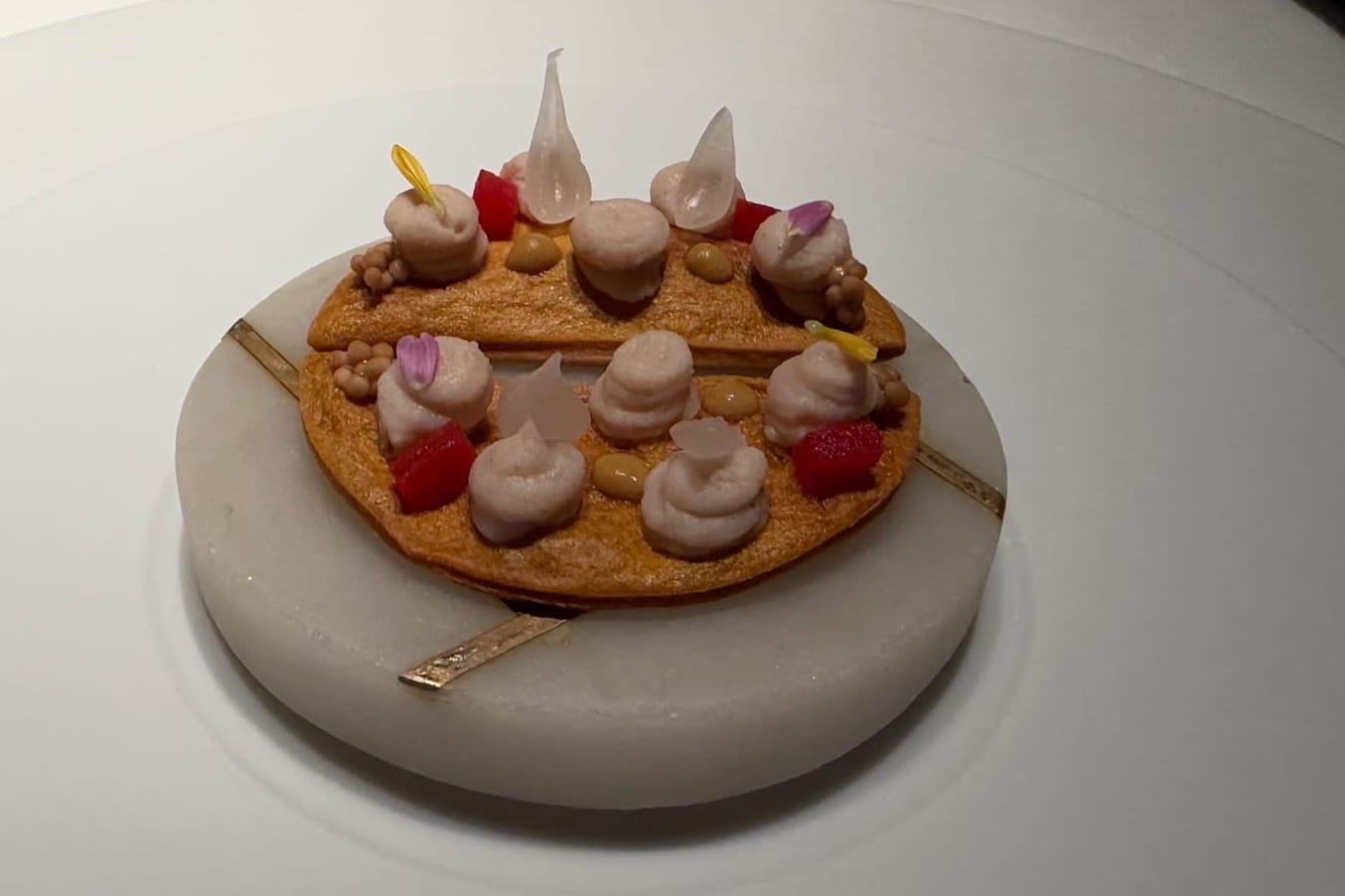
Pork pâté with mustard, banana and pickles, piped onto two crisp half-moons: soft pâté against a brittle base, a good contrast of textures.
A tartare of loin doblao followed.
The taro potsticker was filled with pork lard and cumin.
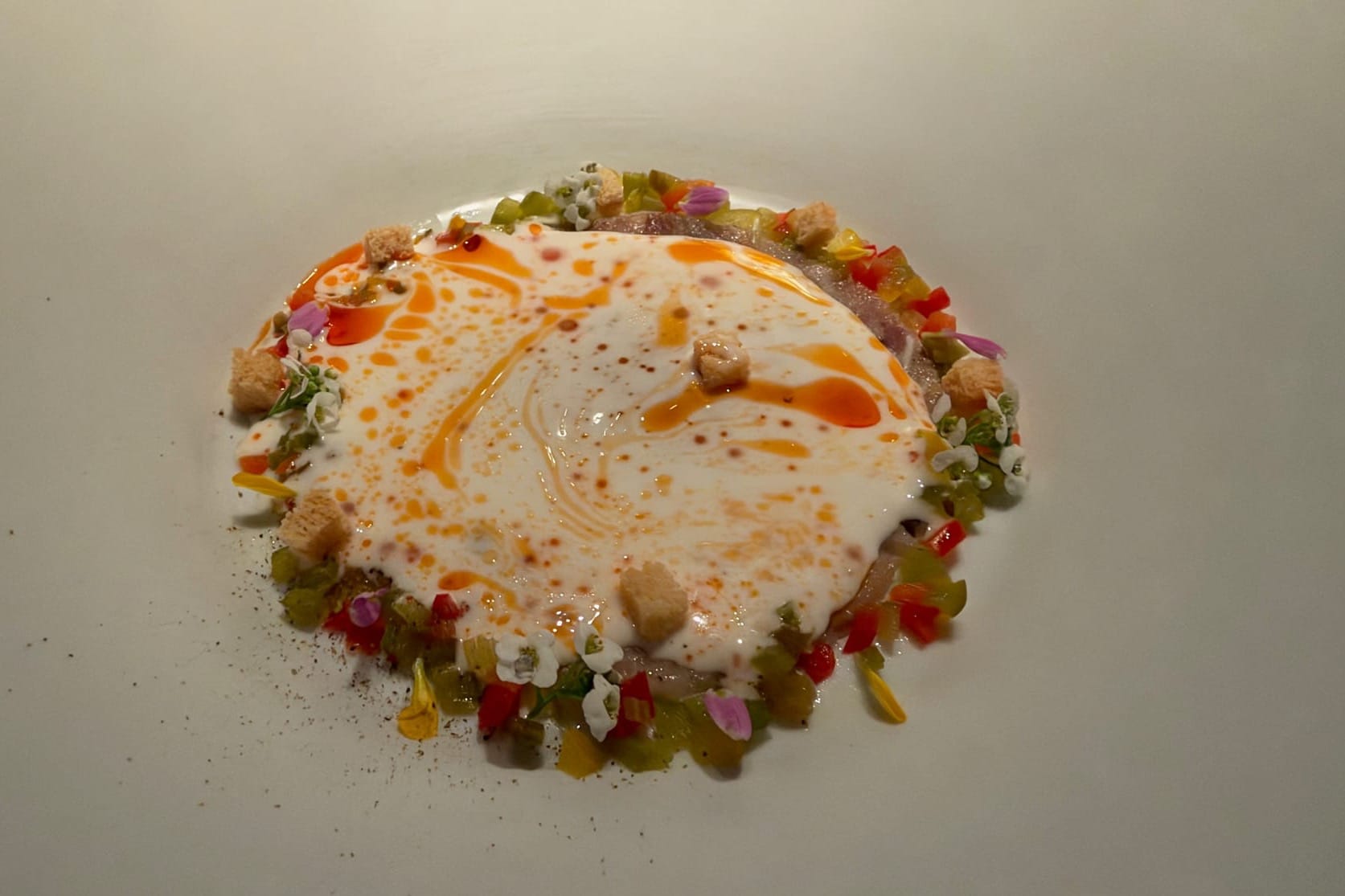
Collagen came pressed into a thin terrine, ringed with diced criolla salad; the paprika vinaigrette, creamy and streaked with orange, was poured over it at the table.
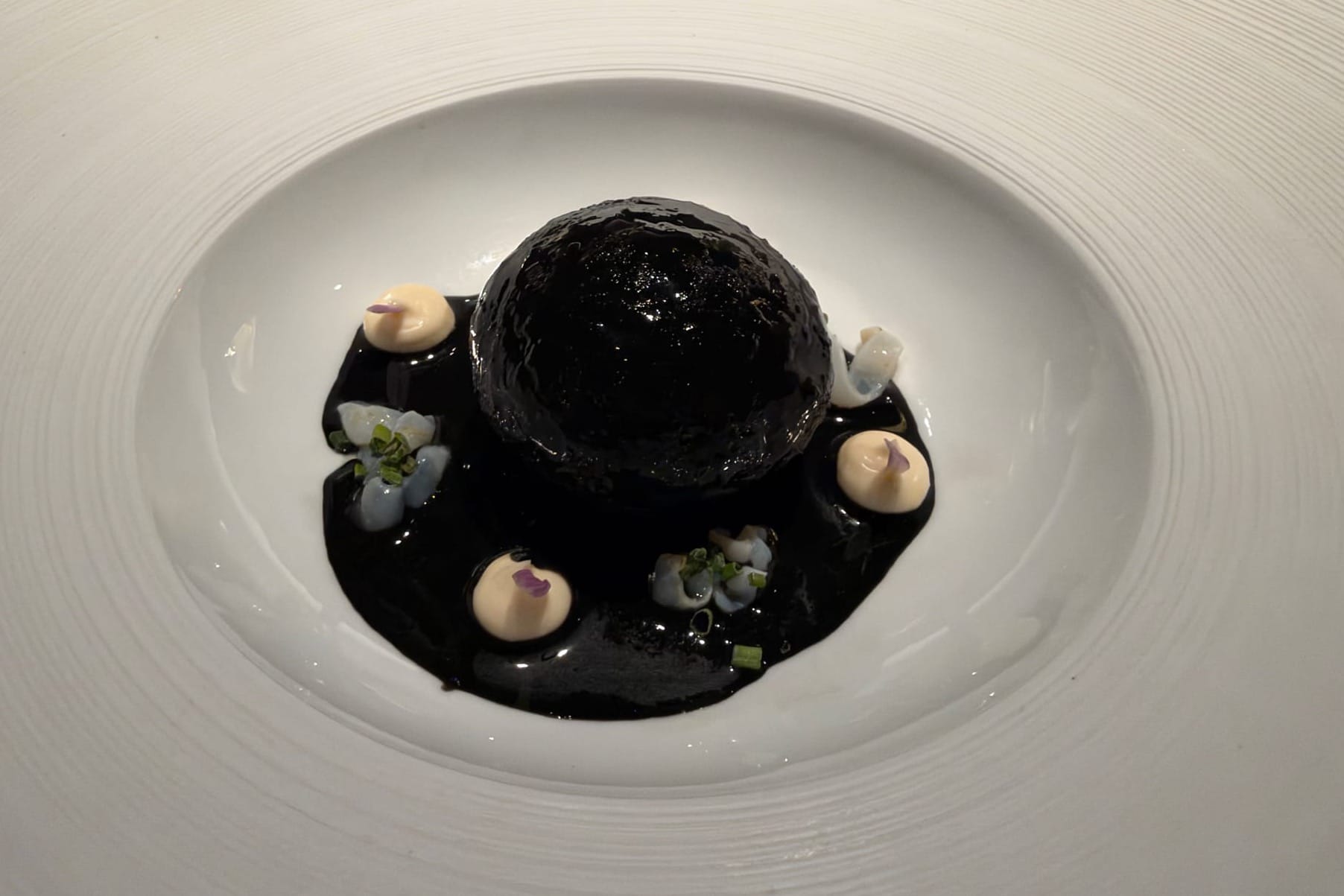
The ink brioche with squid and pig's ear stew I do remember, mostly for its colour. Bread and sauce were both black with squid ink, which pulled the whole plate towards the sea.
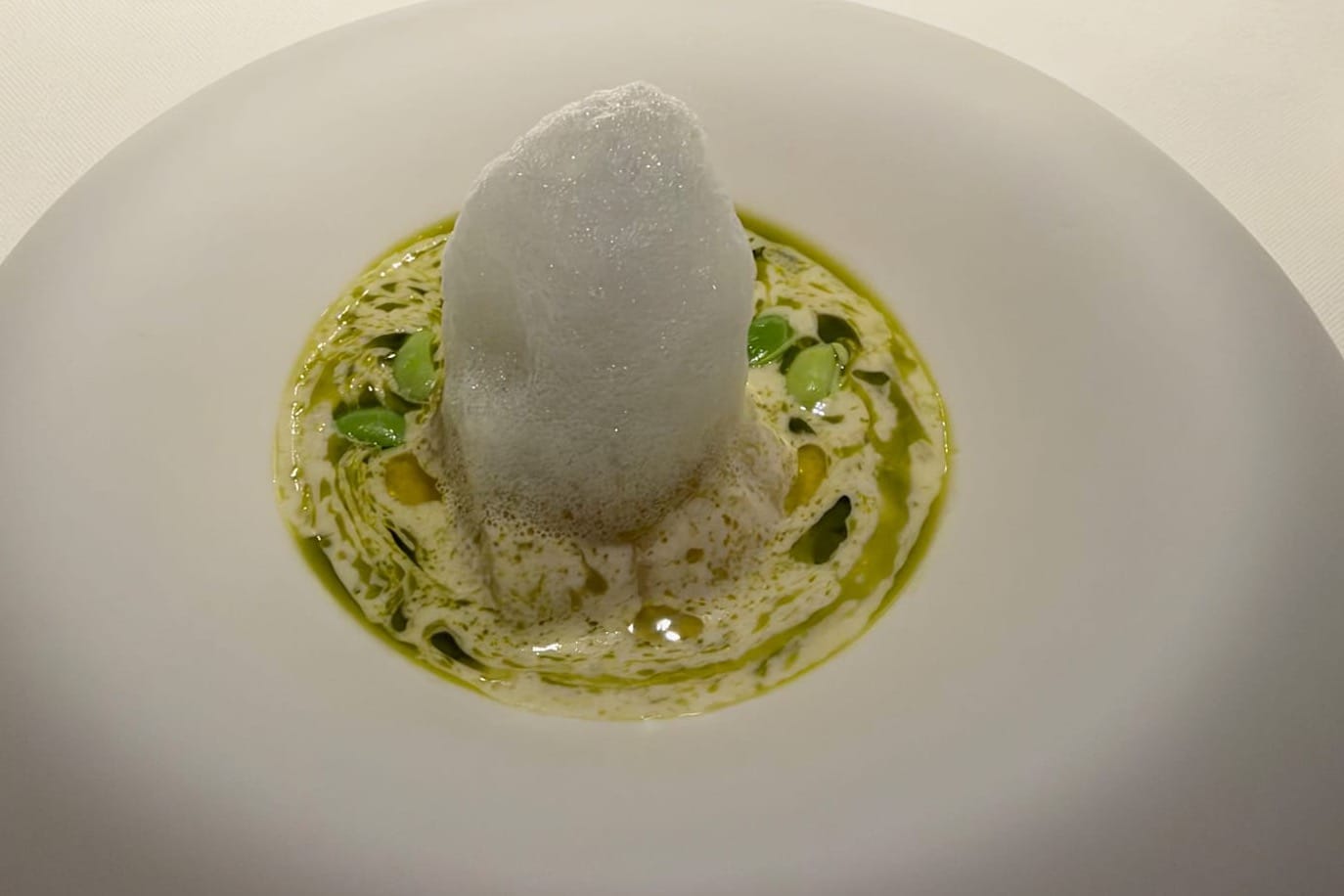
Pork rinds were paired with scallops and a spring onion sauce.
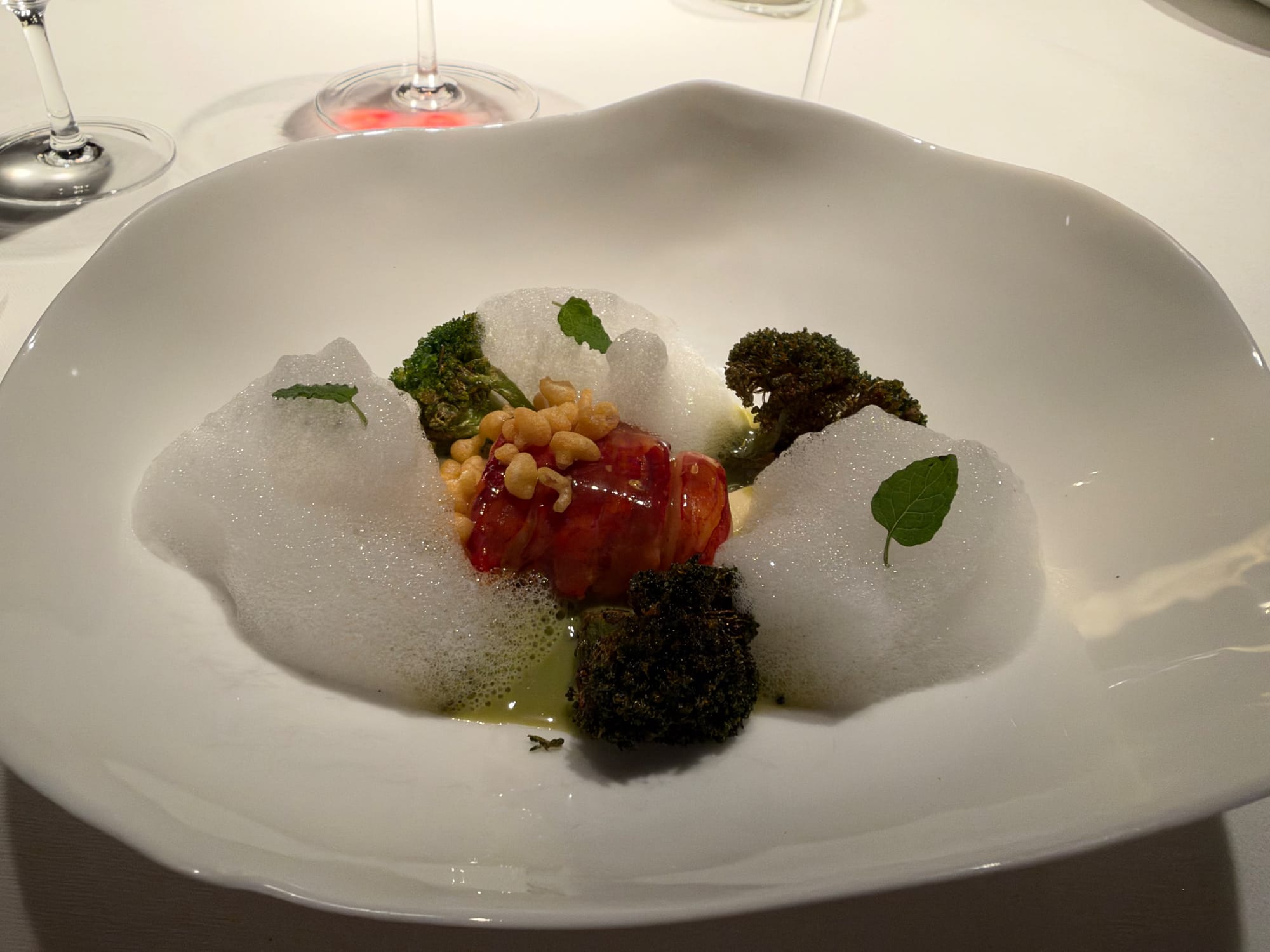
Then the glazed lobster. It came in a pork sauce with green curry and lemongrass, which gave the dish a clear Asian note. Crispy broccoli came alongside and fitted very well, a crunch against the soft lobster and the glaze. This was one of the outstanding dishes of the evening I would go back for.
Pork cheek with crayfish and a creamy chicken broth followed.
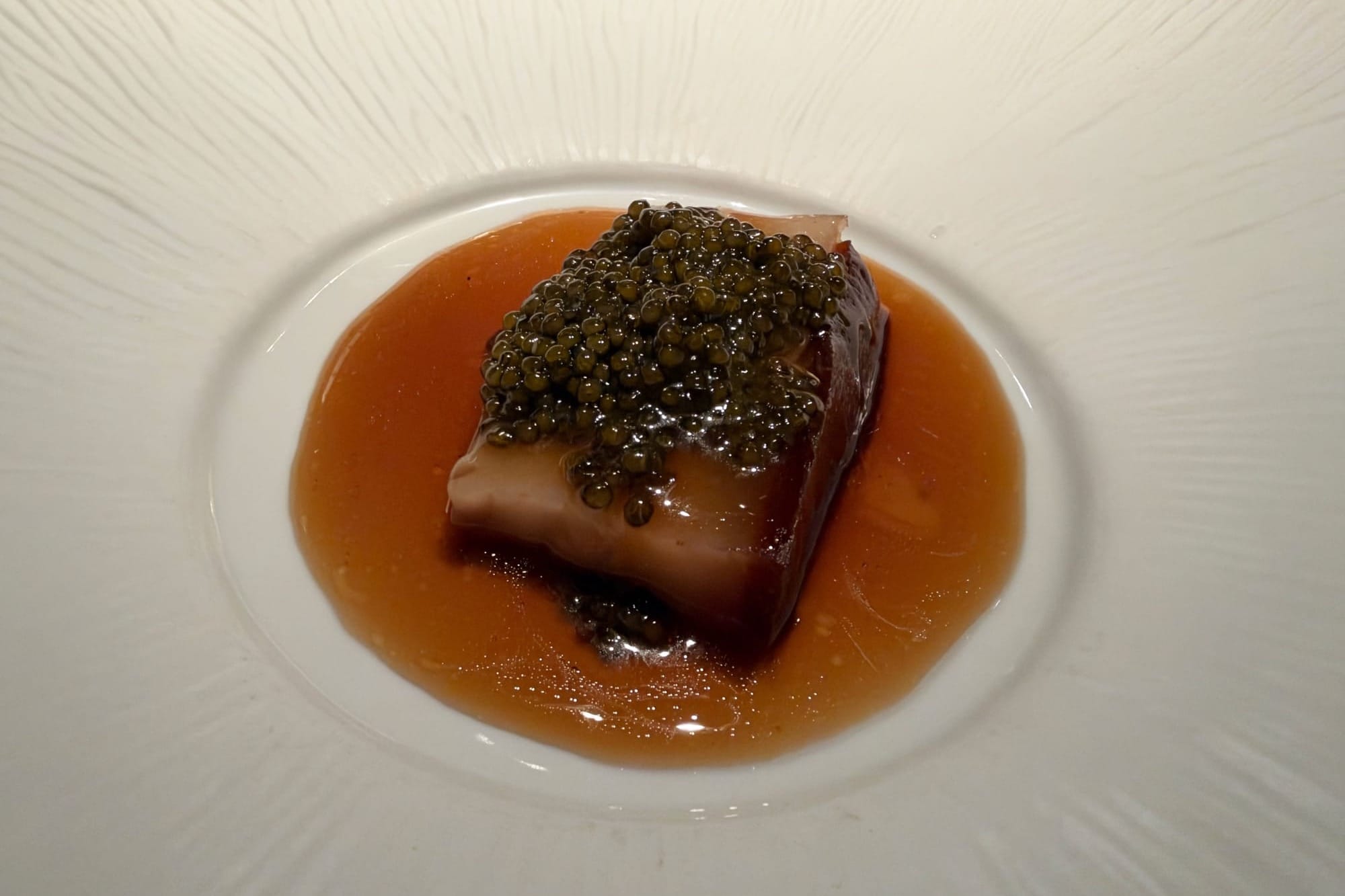
The other was the pork jowl pudding with caviar, and it was the best thing on the menu. Long, slow cooking had taken every bit of resistance out of the jowl. It was soft, sticky with collagen and on the edge of melting, very rich, and the caviar on top answered that richness with salt. In this dish the caviar did the seasoning.
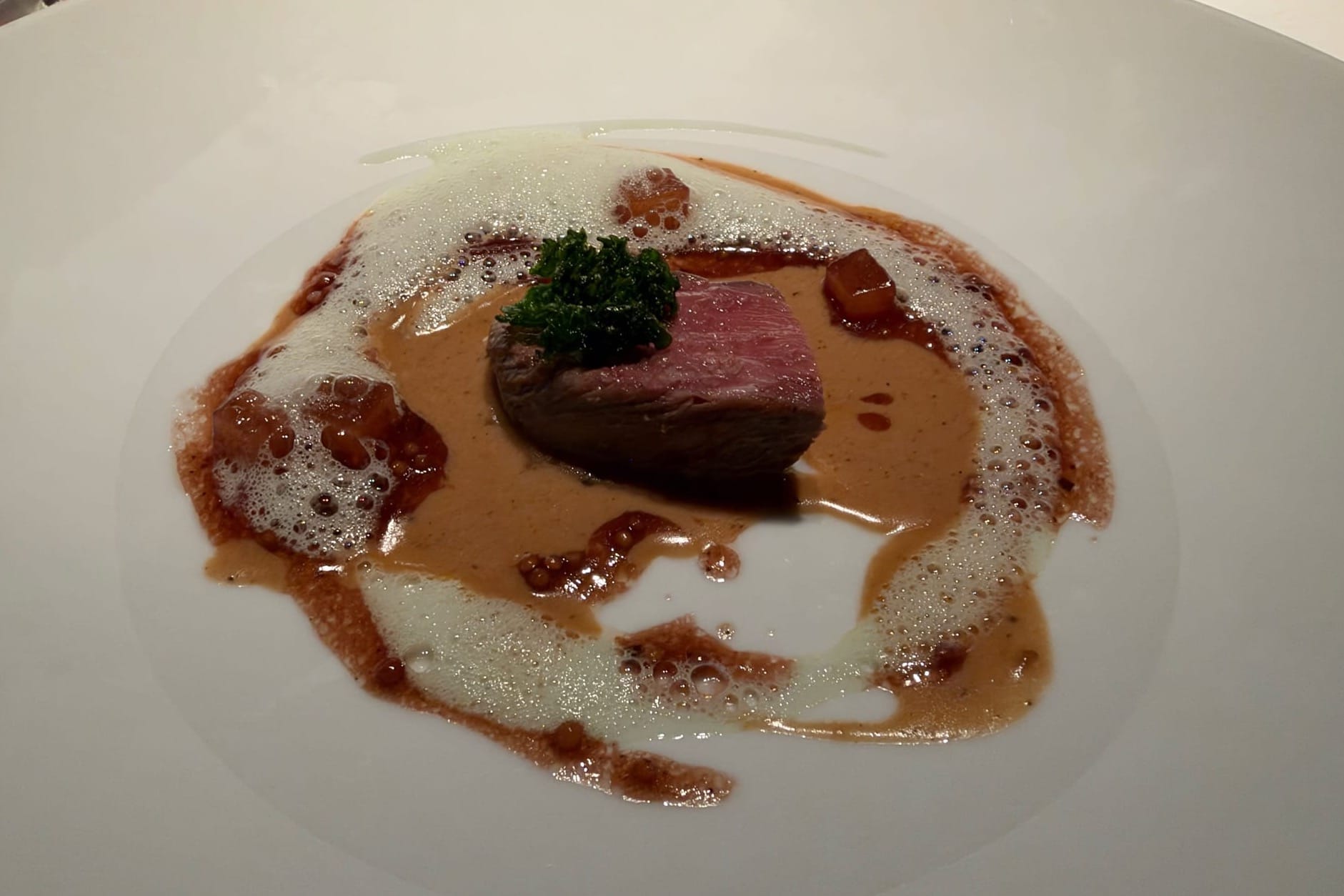
The main course came after seventeen savoury courses, and for the first time that evening the pig stood on its own, with no seafood beside it. Iberian presa, the marbled cut from between shoulder and loin, cooked at low temperature and served with a black pepper sauce. After a menu built on pairings, it was a return to the animal itself.
"Cochinito" Sweet Side
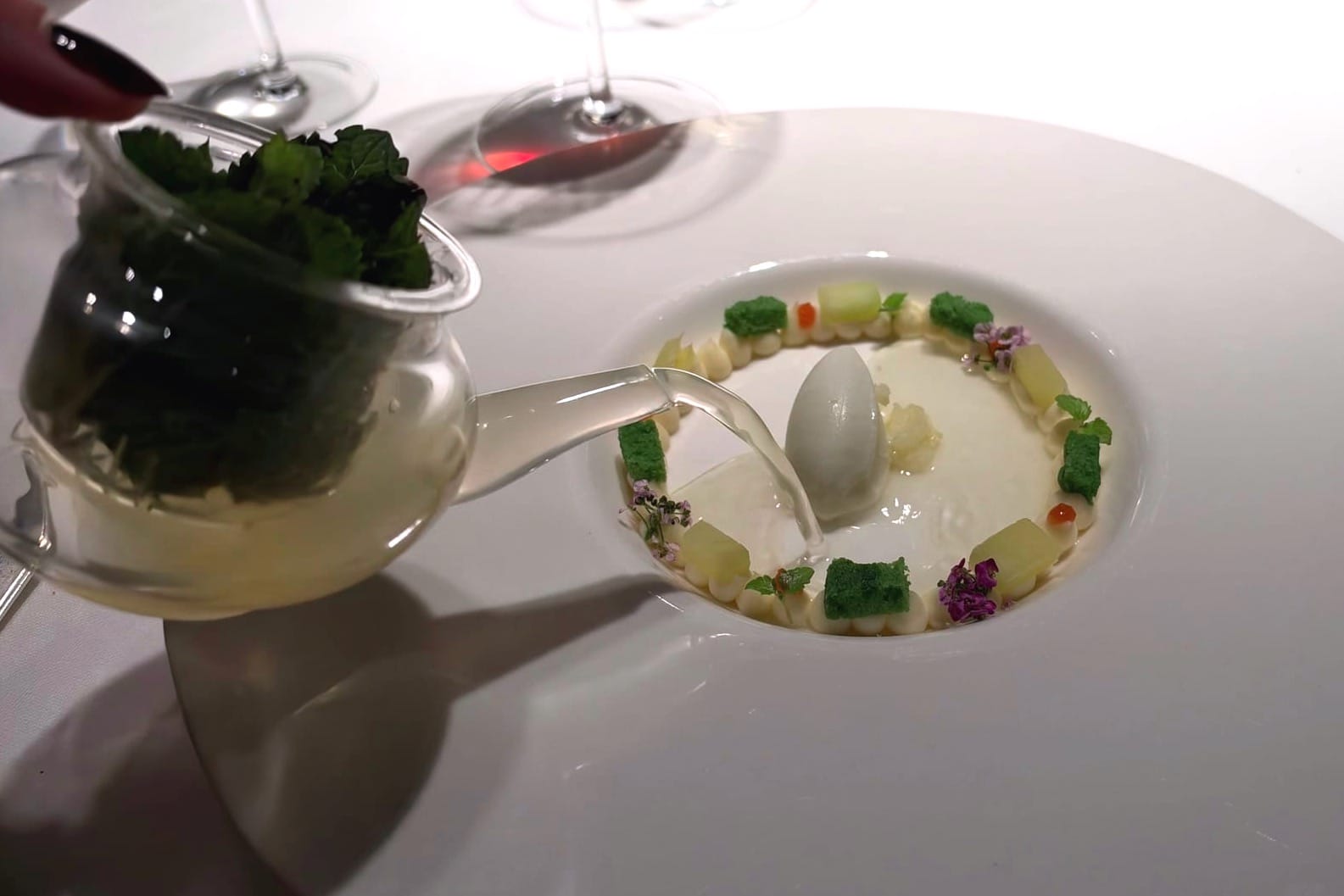
Torta del Casar, Extremadura's soft sheep's cheese, came with quince, matcha and an olive oil biscuit.
Pork rinds turned up again in a yuzu ganache with yoghurt and fennel.
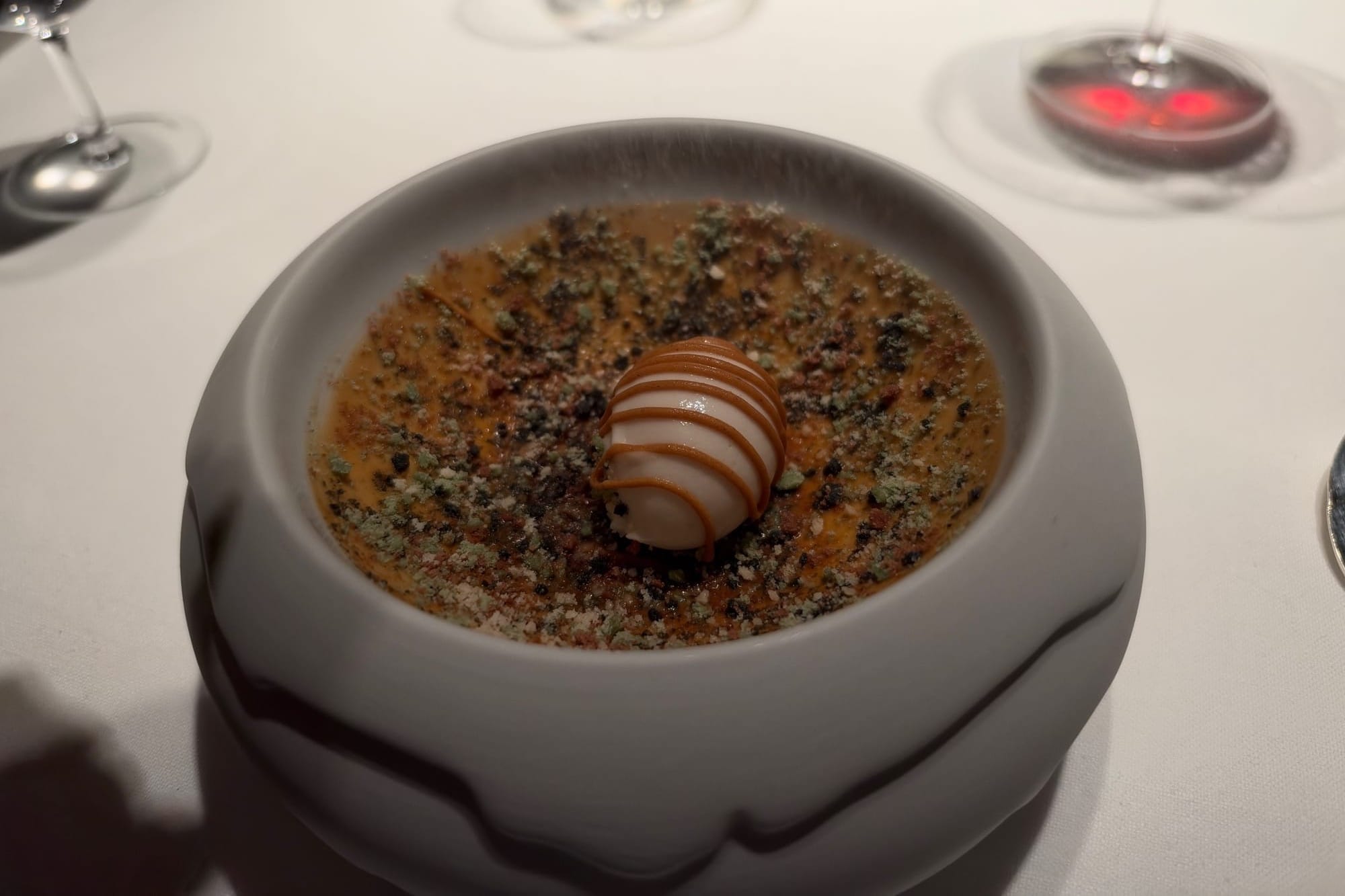
Iberian chocolate came with aged ham and hazelnut, and the fat of the ham played as large a part as the cocoa, running through the chocolate and pulling the dessert back towards the pig.
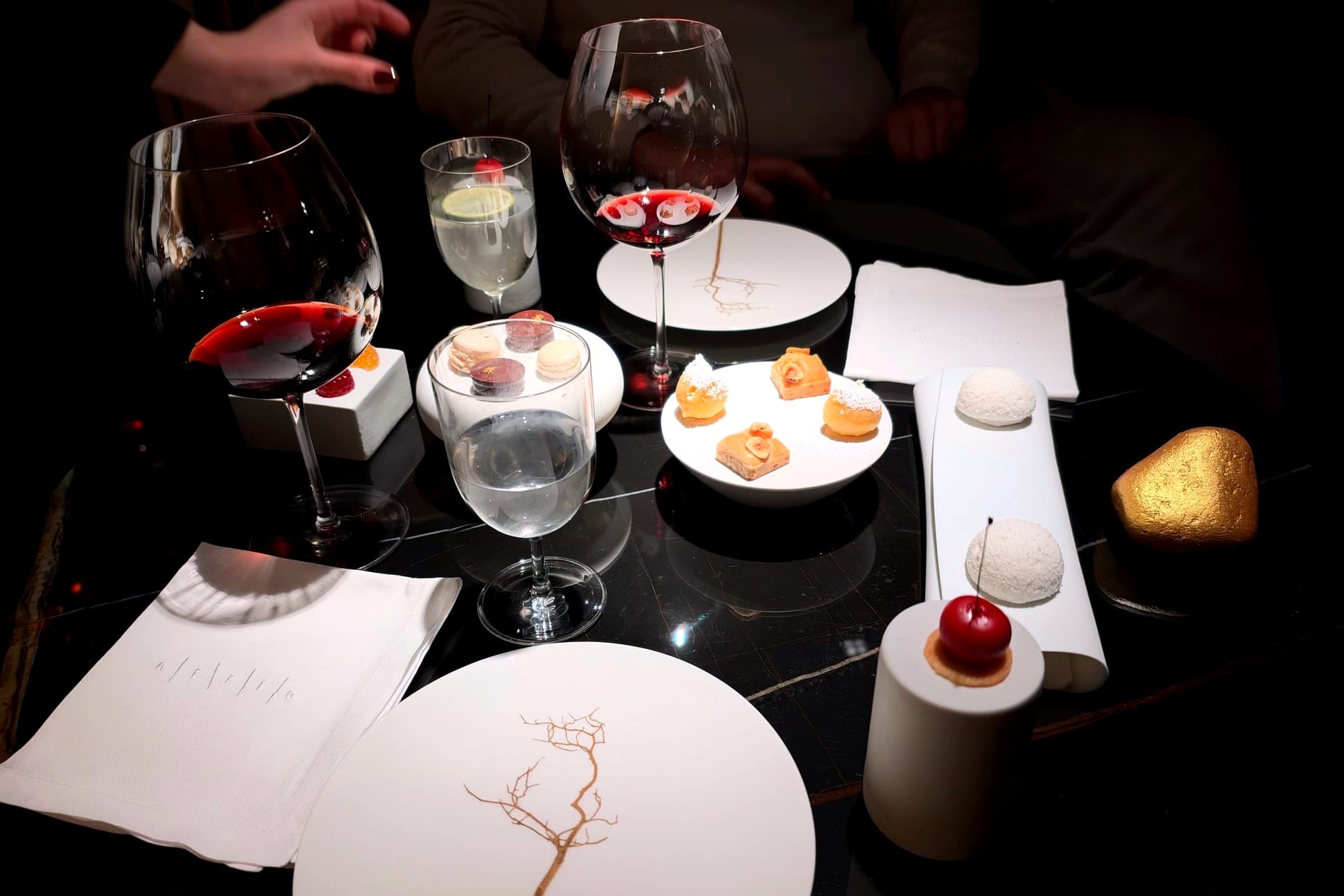
The final dessert served with the Petite fours carried the name The Cherry, Which Is Not a Cherry. It is a cherry taken apart and reassembled from something else, an idea that brings to mind Ferran Adrià's spherical olive at elBulli, although the technique here was different.
Petit fours closed the meal.
Wine
Champagne by the glass started us off: André Clouet Grande Réserve, the Pinot Noir-led cuvée from Bouzy. From the list we ordered two bottles, Miguel Merino Blanco 2023 from Rioja Alta, a Viura and Garnacha Blanca blend, and a Domaine du Pégau Châteauneuf-du-Pape from 2013.
This is where the evening fell short of its own promise. José Polo, Pérez's partner and the man who built the collection, was not in the restaurant. Having just walked through one of the most celebrated cellars in Spain, we found the advice of the sommelier on duty below the level that walk had led us to expect.
Eighteen Years at Two Stars
Michelin gave Atrio its second star in 2004. The third followed in the 2023 guide, presented in Toledo in November 2022, after eighteen years in which many Spanish food writers had been predicting it.
I reached my own conclusion in 2015. Two dinners on consecutive nights during Semana Santa convinced me that the kitchen was already cooking at three-star level, and the guide took more than seven years to say the same. This year's dinner gave me no reason to change my mind.
What I cannot do is compare the menus directly. I no longer have the 2015 dishes in enough detail to say which survived and which are new, so the question of whether the third star changed the cooking, or mainly the waiting list, stays open until a fourth visit.
Verdict
Atrio stages itself before the first course is served. The drive takes hours through the open country of Extremadura, and Cáceres, when it finally appears, looks almost forbidding, its walls and towers built like a fortress. Inside, as in the town's old palaces, plain stone gives way to something else, in Atrio's case a beautiful modern interior. The meal belongs to that whole experience. There is hardly a better place than Extremadura for a restaurant built around the Iberian pig, and Toño Pérez delivers on the idea, in flavour as much as in surprise: the jowl pudding with caviar, the lobster with crispy broccoli and the salchichón are dishes I would make the journey for again.
Two things held the evening back for me. There were too many small courses, served too quickly, and I prefer fewer, more composed plates with time to settle into each one. That is a matter of taste, and in Spain, with its tapas culture, three-star kitchens tend towards a long run of small servings. The wine advice was a small disappointment. With a cellar this famous, we had hoped to be drawn in and to share a passion for wine that this house undoubtedly has, and on an evening when José Polo was away, that did not happen.
Atrio is worth the journey. Since nobody drives to Cáceres for dinner and back, the visit needs at least one night in the town, and two leave time to walk the old town by daylight and again after dark, when the stone is lit and the streets are quiet. For those free to choose their dates, Semana Santa is an especially memorable time to come. Either way, Atrio and Cáceres together are a clear recommendation and one of the most rewarding three-star journeys in Spain.
Location: Plaza de San Mateo 1, Cáceres, Extremadura, Spain
Chef: Toño Pérez
Michelin rating: Three stars (since the 2023 guide)
Visited: November 2026
Menu: Iberian Pork Menu, 22 servings plus petit fours, €295
Disclosure: Booked and paid for as a regular guest.
More from Spain: Casa Marcial, three Michelin stars in the hills of Asturias, and Aponiente in 2026, where Ángel León cooks almost entirely from the sea.