
FDJ Score: 9.0/10 (World-Class Three-Star Level)
Review
Baiersbronn is a small town deep in Germany’s Black Forest, but for anyone interested in serious restaurants it occupies an improbable position on the map. Two three-Michelin-star restaurants are located here: Restaurant Bareiss and the Schwarzwaldstube at Hotel Traube Tonbach.
I came to Restaurant Bareiss for lunch with friends in October 2026 and chose Claus-Peter Lumpp’s full seven-course tasting menu, priced at €350. A shorter lunch menu was available, but having travelled to Baiersbronn specifically to eat here, there was little reason to abbreviate the experience.
That experience lasted around four and a half hours. It never felt long.
This matters because Bareiss belongs to a type of restaurant that has become increasingly rare. The meal is generous rather than reduced, sauces matter, game arrives in two services, cheese comes from a trolley and the end of lunch seems capable of extending almost indefinitely through pâtisserie, chocolates and pralines. None of this feels designed to follow contemporary fine-dining fashion.
After more than one hundred visits to three-star restaurants, that in itself has become unusual. Bareiss does not feel as if it is trying to revive the grand European restaurant. It simply never stopped being one.
Location & Atmosphere
Restaurant Bareiss sits inside Hotel Bareiss in Mitteltal, part of Baiersbronn, surrounded by the wooded hills of the northern Black Forest. The hotel itself holds three Michelin Keys, Michelin’s highest hotel distinction.
The dining room reflects the wider character of the house. It is formal, comfortable and unmistakably classical, with white linen and a style of service that gives the meal a sense of occasion without turning it into ceremony for its own sake.
More important was the warmth behind that formality. We felt genuinely welcome. Four and a half hours at a lunch table can expose weaknesses in pacing very quickly, yet the afternoon remained easy and entertaining throughout.
The service also had personality. At one point one of the sommeliers told us how, when the restaurant was closed during the pandemic, members of the team had gone to work in a vineyard. It was the sort of conversation that makes an experienced dining room feel human rather than rehearsed.
Then there were the trolleys. Cheese, pâtisserie, confiserie: Bareiss still embraces tableside abundance at a time when many restaurants have moved in the opposite direction.
Culinary Style
Claus-Peter Lumpp has led the kitchen at Restaurant Bareiss since March 1992. The restaurant received its first Michelin star in 1984, its second in 1985 and its third in 2007. That third star has remained ever since. Michelin also presented Lumpp with its Mentor Chef Award in 2025.
His cooking is grounded in classical French haute cuisine. Excellent ingredients are cooked accurately, but the defining feature is often what surrounds them: reductions, glazes and sauces with concentration and depth.
There are international references. Garam masala appears with cauliflower, for example, and the opening sequence includes a vegetarian maki. Yet these elements never suggest a kitchen trying to reinvent itself according to the prevailing fashion.
That separates Bareiss from many of Germany’s other three-star restaurants. Haerlin in Hamburg, for example, has evolved towards an increasingly refined modern expression of French cooking, while Tohru in der Schreiberei builds its identity from a dialogue between French and Japanese traditions. Bareiss seems less interested in evolution as a virtue in itself.
Menu / The Dishes
The meal opened with an Apéro Étagère, including a small onion tart and a vegetarian maki alongside two further bites that I no longer remember clearly. Rather than reconstructing them from a menu, I will leave the memory where it is. What remains more clearly is the impression of generosity from the outset.
Cold and warm amuse-bouches followed. The warm course included a lobster raviolo, already pointing towards the style of cooking that would dominate lunch: classical technique and concentrated flavour rather than minimalism.
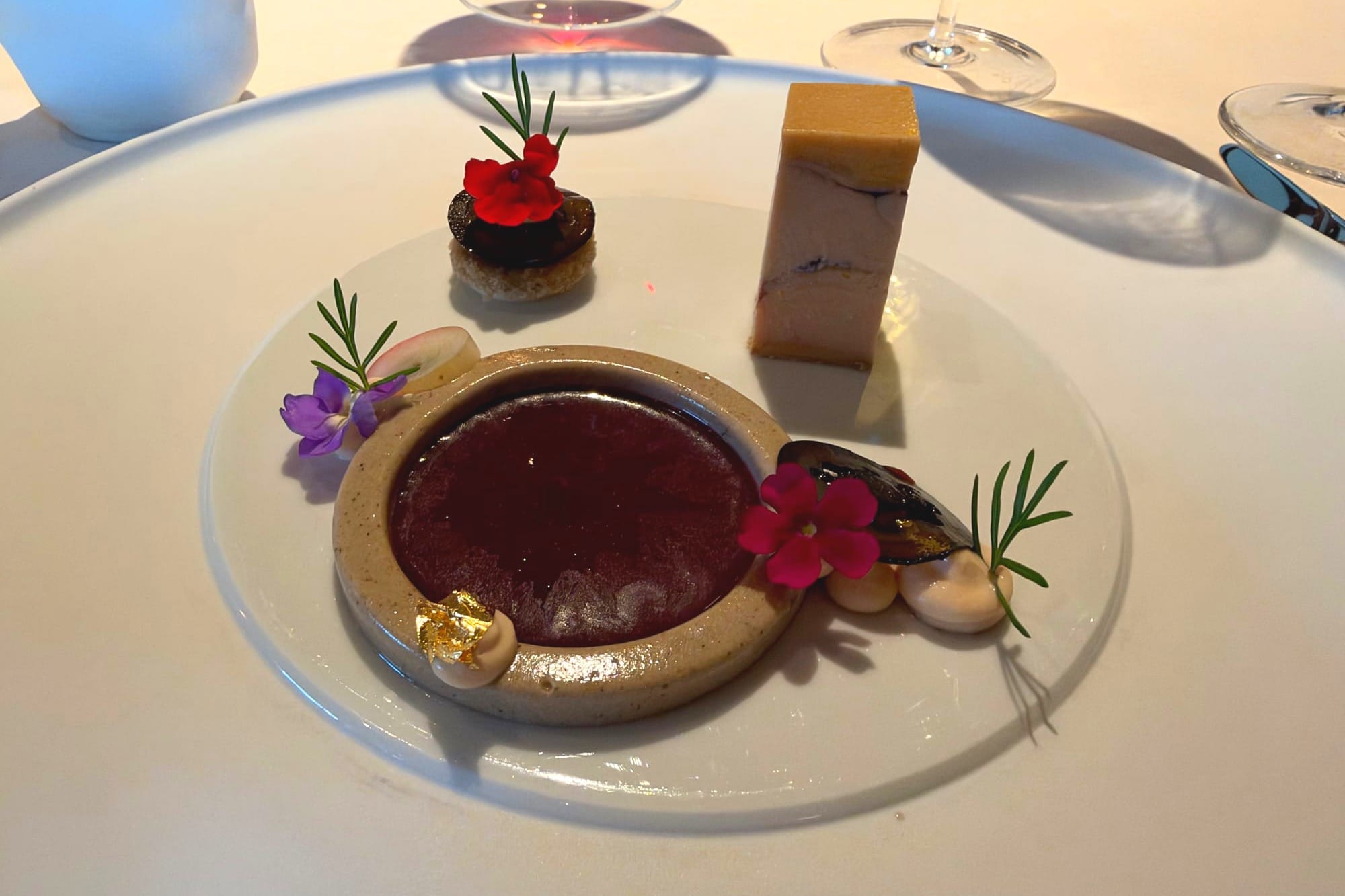
Variation of Foie Gras
Fragolino grapes and black walnuts
The actual course was a variation of foie gras with Fragolino grapes and black walnuts.
Three preparations arrived together: warm pan-fried foie gras, terrine and mousse. It was an unapologetically classical plate, rich in both conception and execution.
The black walnuts gave it a more distinctive autumnal edge. Made from walnuts harvested while still green and preserved until they become dark, sweet, spiced and slightly tannic, they cut through some of the richness. The Fragolino grapes added fruit and freshness.
Nothing about the dish attempted to disguise the nature of foie gras. Bareiss served it with conviction and allowed contrast to come from the accompaniments.
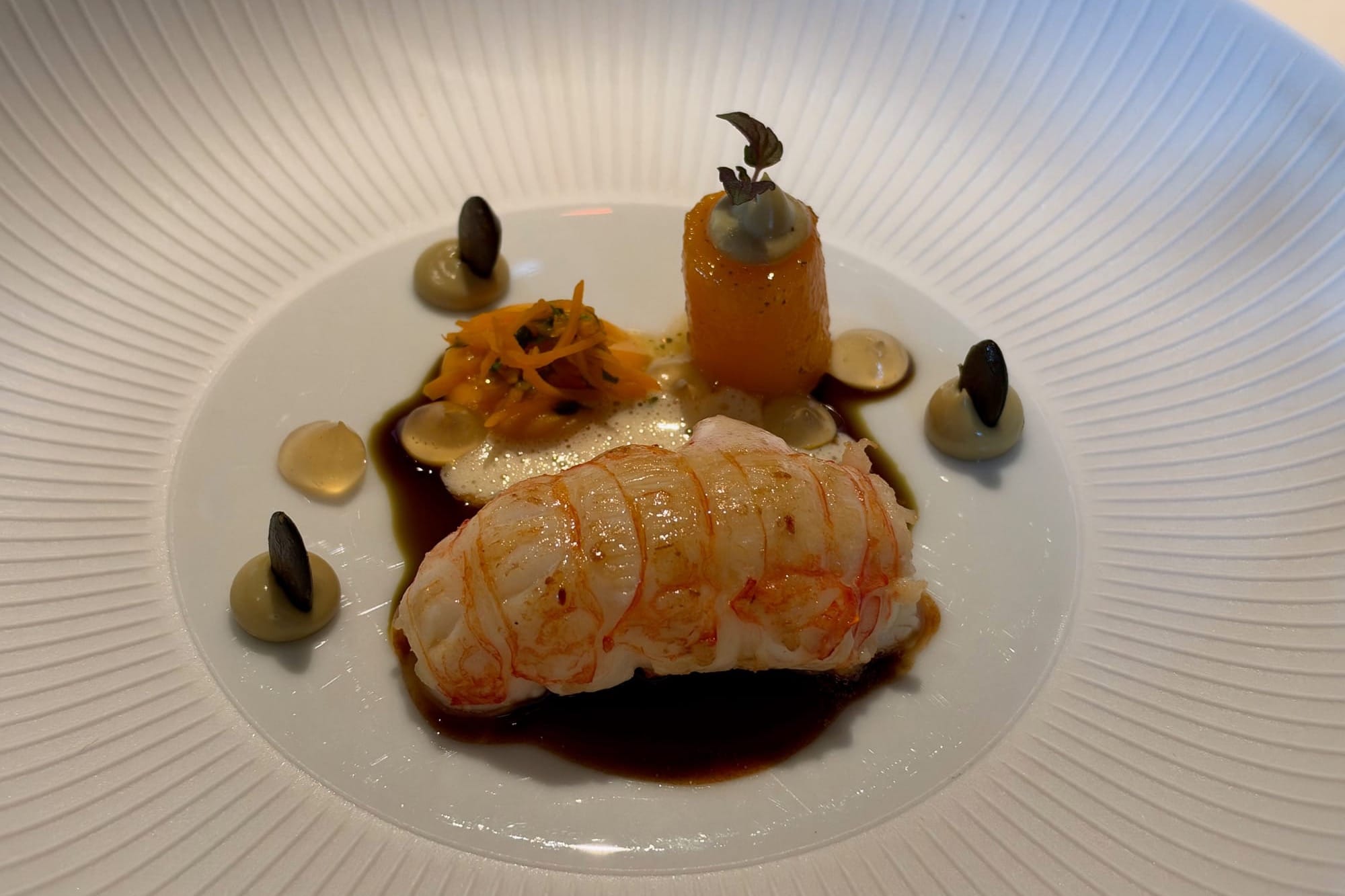
Sautéed Langoustine
Pumpkin, verbena and crustacean glaze
The sautéed langoustine came with pumpkin, verbena and a crustacean glaze.
Langoustine is an ingredient that leaves very little margin for error. Its flesh contains highly active protein-breaking enzymes, and if the cooking is mishandled the texture can quickly turn soft and almost mushy rather than firm and succulent. Here the timing was exact. The langoustine retained that delicate, slightly translucent texture that makes Kaisergranat so appealing, while still having enough structure to carry the concentrated crustacean glaze.
The crustacean glaze supplied the depth. This was one of several moments during lunch when the sauce was not merely an accompaniment but an essential part of the dish.
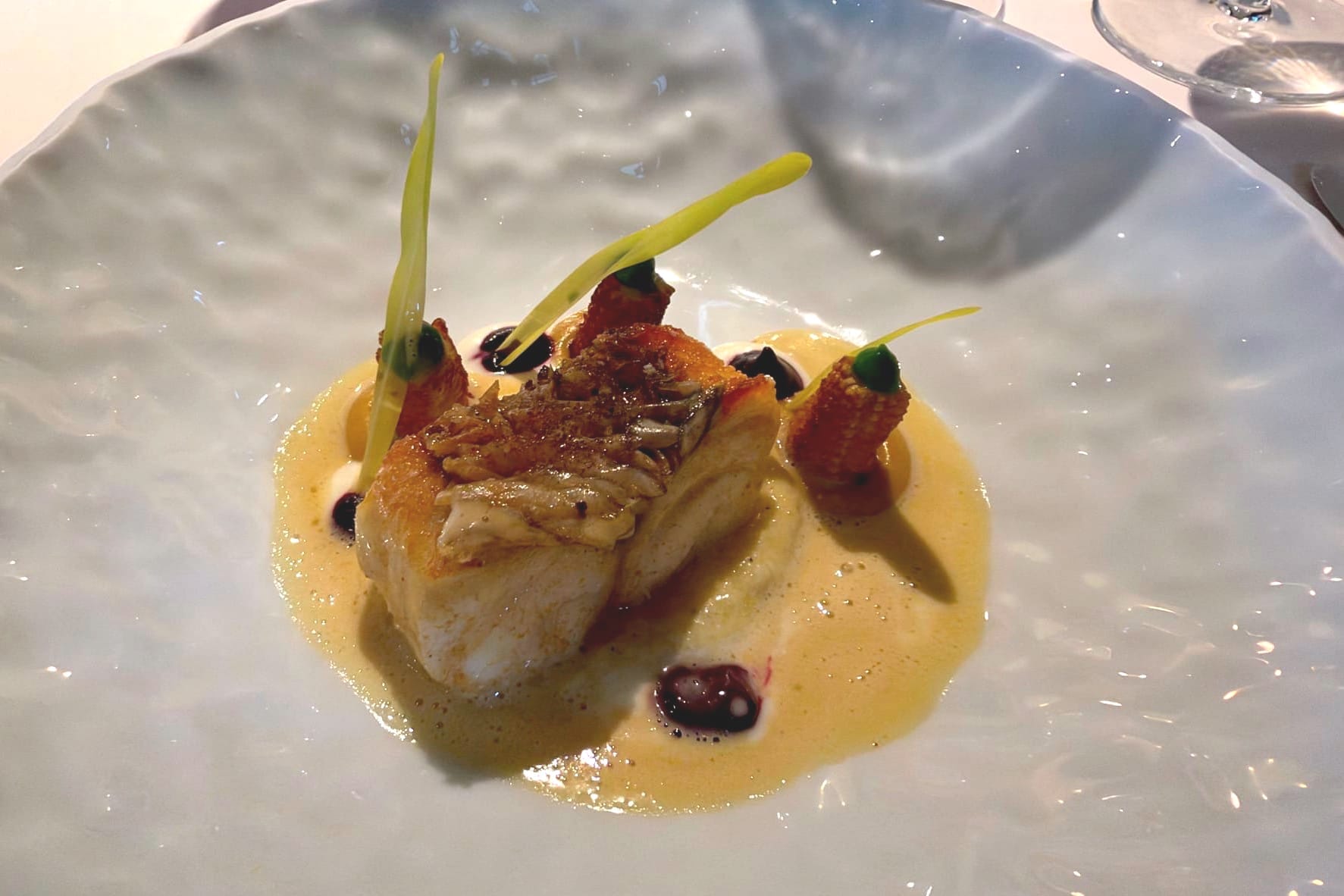
Crispy Sea Bass
Smoked corn, cassis and sour cream
Sea bass followed with smoked corn, cassis and sour cream.
Again, the cooking of the main ingredient was excellent. The skin was properly crisp while the flesh remained moist. Smoked corn, cassis and sour cream could easily have pulled the dish in too many directions, but the supporting elements remained sufficiently controlled for the fish to stay at the centre.
It was accomplished rather than startling, which also describes one of my reservations about the menu as a whole. The technical standard was extremely high, but not every plate left an equally strong individual memory.
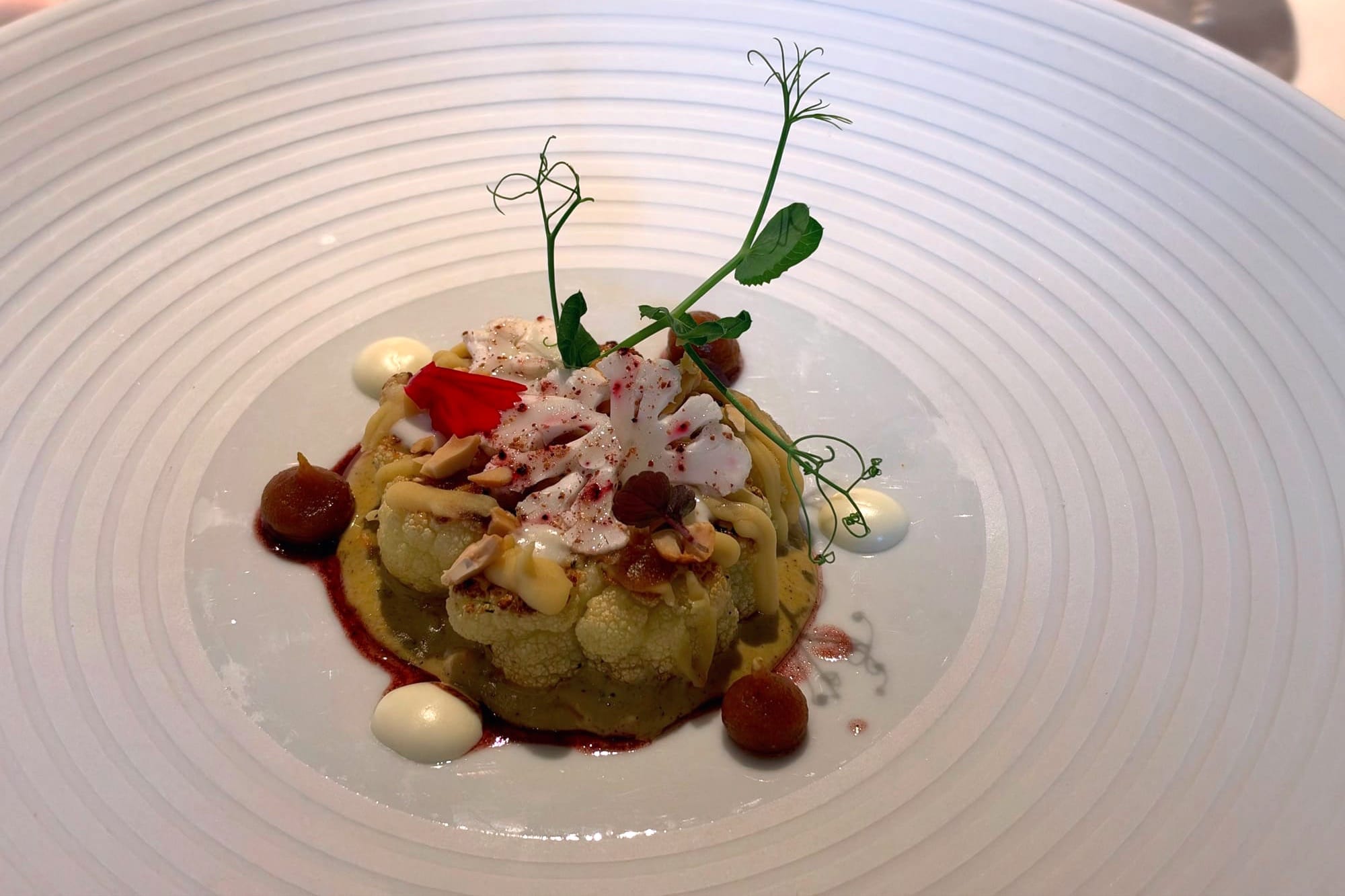
Cauliflower
Chickpea, date, cashew nuts and Garam Masala sauce
The cauliflower with chickpea, date, cashew nuts and Garam Masala sauce was the clearest departure from the French-classical line.
After lunch Lumpp came to our table and stayed for some time. When we discussed this course, he said, with considerable amusement, that he finds cauliflower on its own rather boring and therefore believes it needs substantial seasoning.
He certainly provided it.
The Garam Masala sauce gave the course warmth and intensity, while chickpea, date and cashew pushed it towards an explicitly Indian flavour profile. In another menu it might have felt disconnected. Here its role was almost to interrupt the succession of classical luxury before the main course.
Venison from the Bareiss Hunt
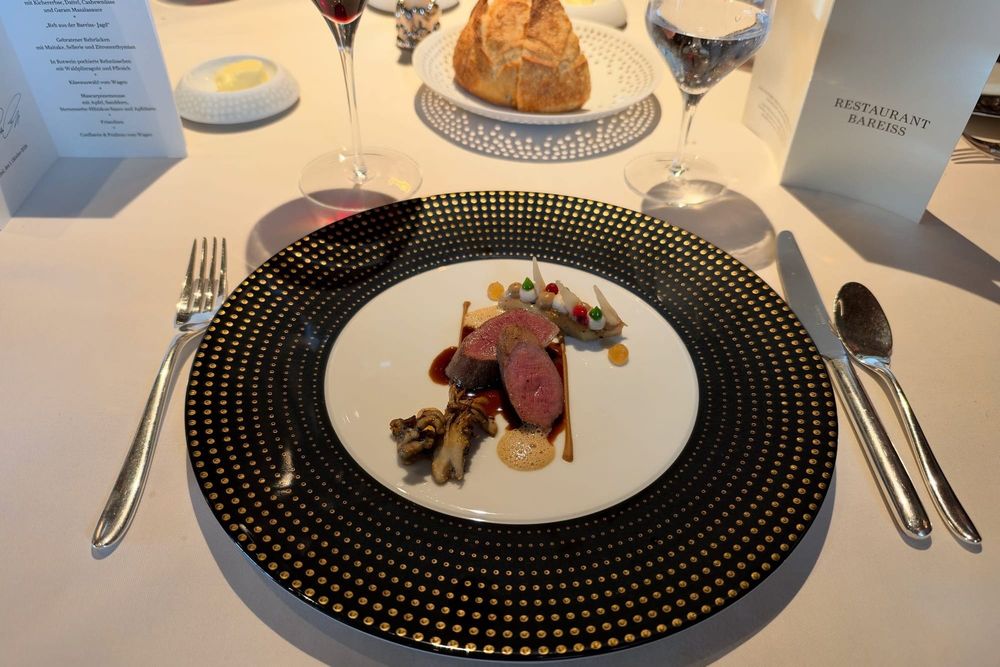
The main course was Reh aus der Bareiss-Jagd, served in two stages.
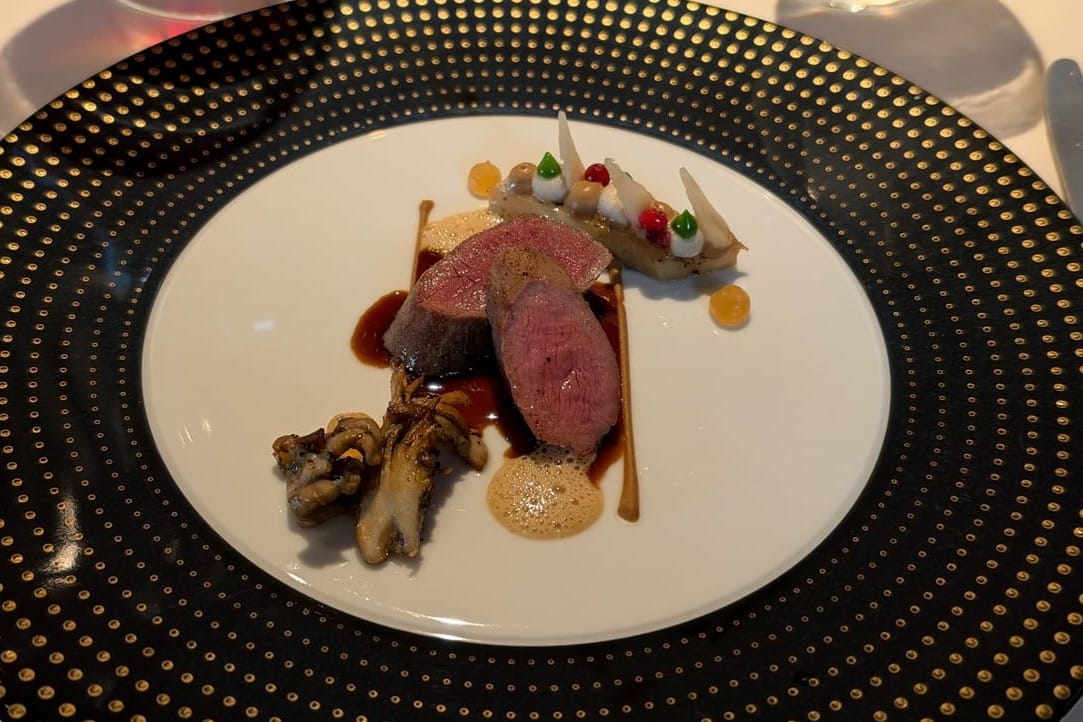
Roasted Saddle of Venison
Maitake, celeriac and lemon thyme
First came roasted saddle of venison with maitake, celeriac and lemon thyme. The meat was beautifully cooked and the flavour of the venison remained the focus rather than disappearing beneath its garnishes.
Venison Medallion Poached in Red Wine
Wild mushroom ragout and peach
A second plate followed: a venison medallion poached in red wine with wild mushroom ragout and peach.
Serving game in two preparations feels almost anachronistically generous today, which is exactly why it worked here. This was a main course in the traditional sense, not merely the final savoury plate before dessert. It had weight and a sense of arrival.
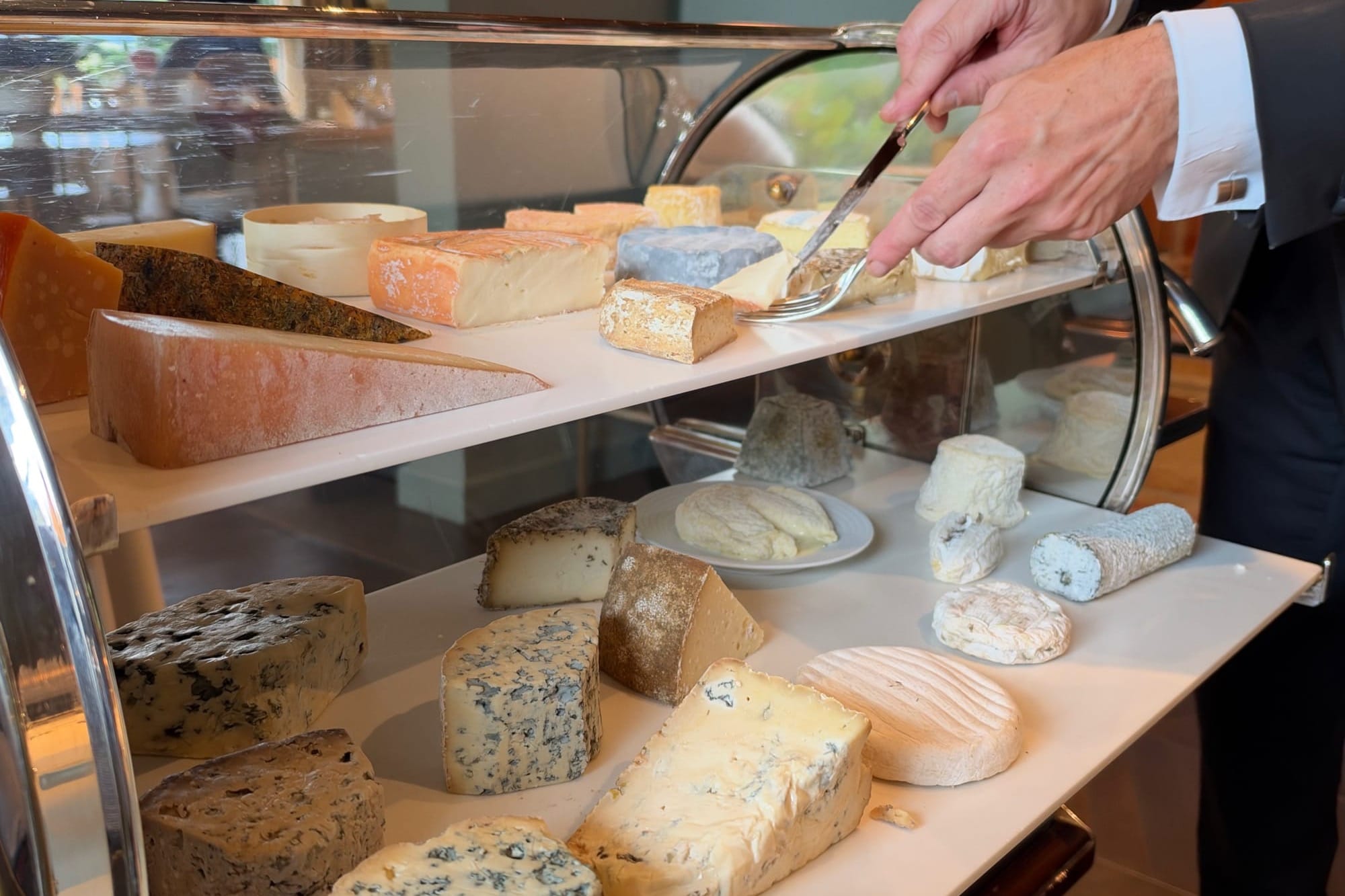
Cheese Selection from the Trolley
Cheese was presented from a traditional Christofle trolley.
The distinction is more important than it sounds. Instead of receiving three predetermined pieces arranged by the kitchen, we could look, discuss and choose. The trolley turns cheese back into a conversation between guest and dining room, one of several small rituals Bareiss has chosen not to discard.
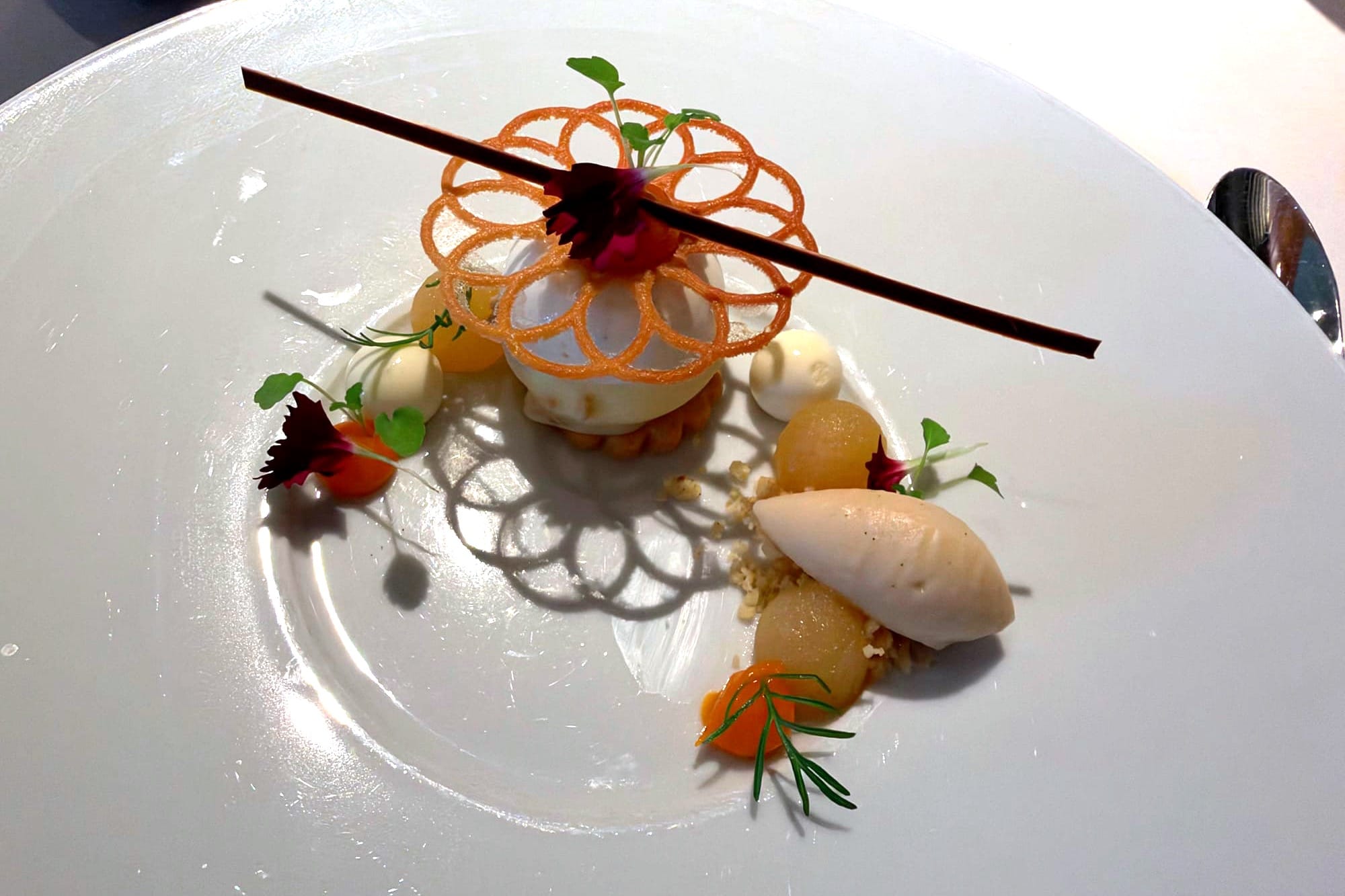
Mascarpone Mousse
Apple, sea buckthorn, Sternrenette-Hibiscus sauce and apple tart
Dessert combined mascarpone mousse, apple and sea buckthorn with Sternrenette apple and hibiscus sauce and an apple tart.
After foie gras, langoustine, sea bass, spiced cauliflower, two preparations of venison and cheese, its fresher character was welcome. Apple and sea buckthorn brought enough acidity to pull the menu away from its earlier richness.
Then came the friandises, although at Bareiss that description understates what happens.
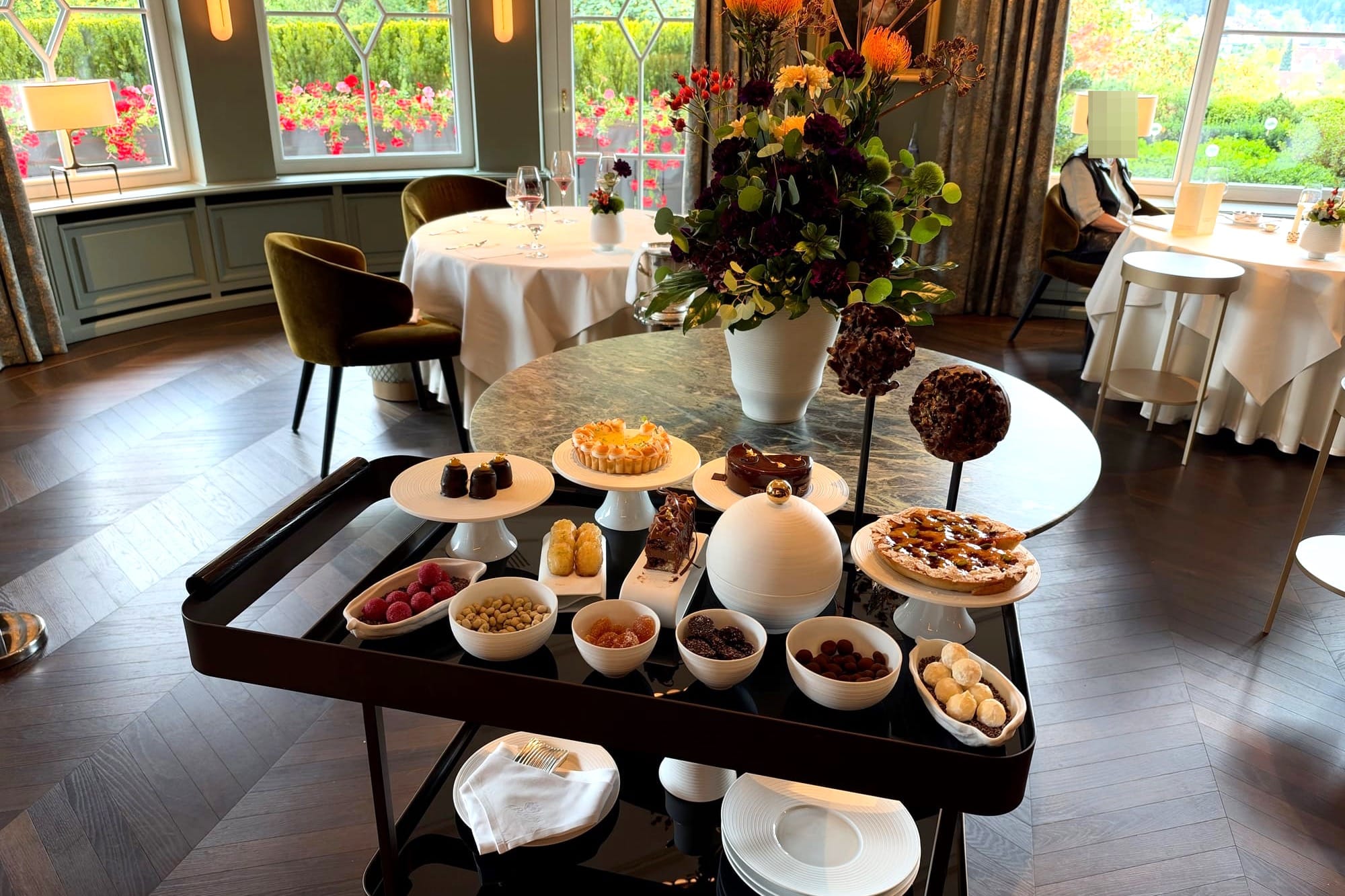
A pâtisserie trolley appeared with small cakes, tartlets and pastries. We also decided that being in the Black Forest and leaving without eating Schwarzwälder Kirschtorte would be unnecessarily disciplined, so we ordered a slice separately. It was not part of the tasting menu.
Finally another trolley arrived with handmade chocolates and pralines.
By then the restaurant had been feeding us for several hours. Bareiss still seemed prepared to continue.
Wine
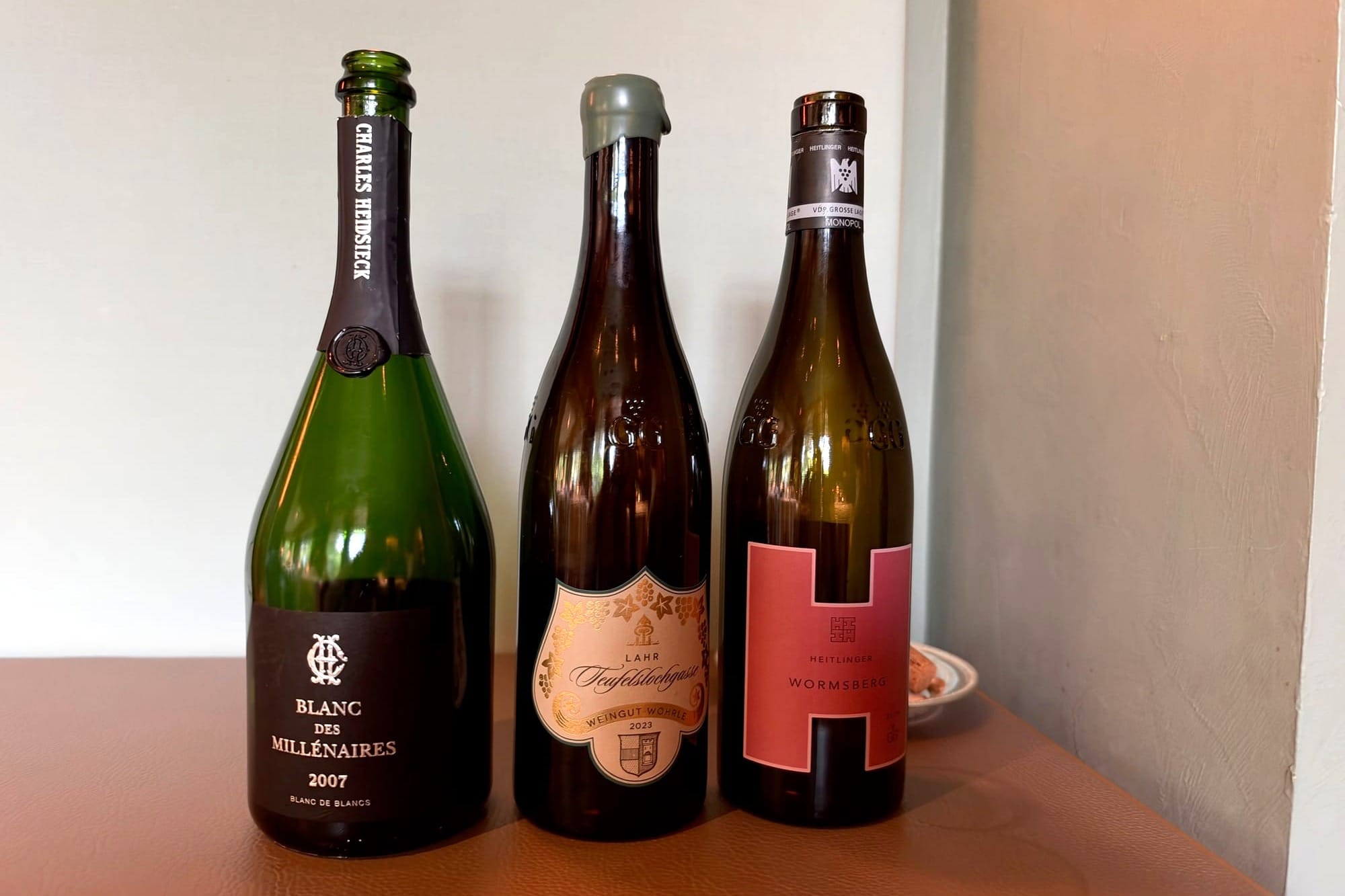
We drank three bottles over lunch rather than taking a formal wine pairing:
Charles Heidsieck Blanc des Millénaires 2007
Weingut Wöhrle Teufelslochgasse Chardonnay GG 2023
Weingut Heitlinger Wormsberg Pinot Noir GG 2010
The progression worked particularly well for this style of food. Blanc des Millénaires provided the opening maturity and depth, before the Baden Chardonnay moved naturally towards the richer seafood courses.
The mature Heitlinger Pinot Noir was the most obvious match for the latter part of the menu. By the time the venison arrived, the 2010 had enough development to meet the mushrooms and red-wine-poached meat without overwhelming them.
There was also something appropriate about ending a Black Forest lunch with mature Baden Spätburgunder.
When Being Old-Fashioned Becomes Distinctive
Restaurants often talk about having an identity. Bareiss demonstrates what that means when the identity has been built over decades rather than devised as a concept.
Parts of the meal undoubtedly feel old-fashioned. Three preparations of foie gras, game in two services, substantial sauces and multiple trolleys do not represent the dominant direction of contemporary fine dining. Someone looking primarily for lightness, radical reduction or constant novelty may find parts of the experience dated.
That is a genuine limitation, but also the central contradiction of Bareiss.
I have eaten in enough three-star restaurants where modernity is expressed through smaller portions, more courses, fermented ingredients and increasingly abstract plating that the absence of those signals can itself feel refreshing. Bareiss does not need to demonstrate relevance every few minutes.
The stronger comparison is with houses such as Le Louis XV in Monaco, another restaurant where classical luxury remains meaningful when technique and hospitality are strong enough to support it. The difference is geographical and cultural. Ducasse expresses Mediterranean grandeur in Monte Carlo; Lumpp’s version belongs unmistakably to a grand Black Forest hotel.
Bareiss is therefore not compelling because it preserves the past unchanged. It is compelling because the old format still works.
Verdict
Restaurant Bareiss delivered a world-class three-star lunch. The cooking was consistently precise, the ingredients excellent and the hospitality unusually generous. The langoustine, the venison sequence and the depth of the sauces showed why Claus-Peter Lumpp has remained at this level for so long, while the four-and-a-half-hour service passed without feeling remotely laborious.
The reservation is that the same traditionalism giving Bareiss its identity can occasionally make the food feel more accomplished than surprising. Some combinations and presentations belong unmistakably to an earlier vocabulary of haute cuisine, and not every course created the emotional impact of the strongest plates. For diners seeking relentless novelty, this may not be the obvious three-star restaurant to choose.
For anyone interested in classical European grand dining, however, Restaurant Bareiss is absolutely worth the journey. It offers something increasingly difficult to find: not a nostalgic reconstruction of grande cuisine, but a restaurant that has simply continued practising it at an exceptionally high level.
A Walk to the Next Three-Star Dinner
After four and a half hours at the table, some exercise felt less like an option than a necessity.
Rather than drive to our next destination, we left Hotel Bareiss on foot and walked through the forest towards Hotel Traube Tonbach. The route took us past the Wanderhütte Sattelei, Bareiss’s hiking hut above Mitteltal, before continuing through the forest towards the Tonbach valley.
The walk took a little over an hour and proved to be an unusually pleasant way to bridge two meals.
There cannot be many places where you can finish lunch at one three-Michelin-star restaurant, walk through the countryside for an hour and arrive at another. That is part of what makes Baiersbronn so unusual. These are not two restaurants in the same major city. They sit in neighbouring valleys in the Black Forest, close enough to reach each other on foot.
We also had a reason not to take too long. At 8 p.m., our next reservation was waiting at the Schwarzwaldstube.
After four and a half hours at Bareiss, another three-star dinner on the same day was perhaps not the most restrained piece of scheduling. The walk through the forest, at least, gave us a little time to prepare.
Location: Baiersbronn-Mitteltal, Black Forest, Germany
Chef: Claus-Peter Lumpp
Michelin rating: ★★★
Visited: October 2026
Menu: Seven-course Degustationsmenü, €350
Disclosure: Booked and paid for as a regular guest.